

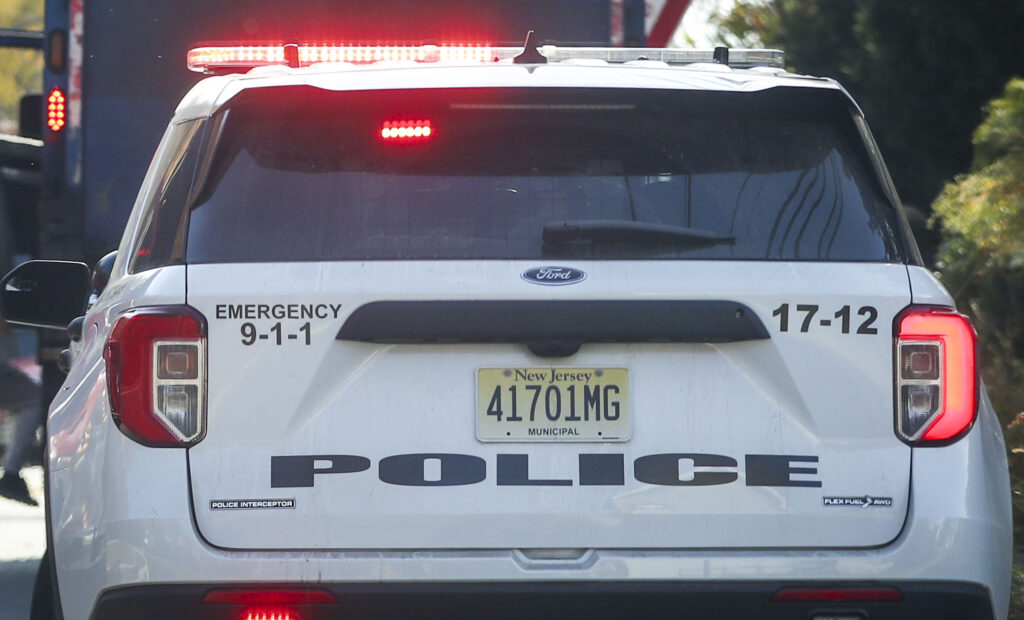
New Jersey launched Arrive Together in 2021 to help police handle people in crisis. The two leading candidates for governor support the program. (Dana DiFilippo | New Jersey Monitor)
As New Jersey prepares to elect a new governor, advocates for a state program that pairs mental health specialists with police officers for certain public safety calls say they hope our next chief executive doesn’t jettison the program.
The Attorney General’s Office launched Arrive Together in 2021 as an effort to decrease police use of force against civilians experiencing behavioral health issues. It started as a program in Cumberland County and has since expanded to all 21 counties, with state officials saying there have been no serious injuries to either officers or civilians in 12,000 interactions.
“We hope that no matter who is elected, that they not only keep this program in place, but would continue to build on it,” said Surraya Johnson, director of the criminal justice reform program at the New Jersey Institute for Social Justice.
The program — Arrive stands for Alternative Responses to Reduce Instances of Violence and Escalation — has been championed by Gov. Phil Murphy, a Democrat, and Attorney General Matt Platkin, both of whom are departing in January when a new governor is sworn in.
The front-runners vying on Nov. 4 to replace Murphy, Republican Jack Ciattarelli and Democrat Mikie Sherrill, both extol Arrive Together, though Ciattarelli indicated that if elected, he may revamp the program. He said police officers need to know the next governor “has their back” in these situations.

Ciattarelli, who has criticized Murphy and Platkin for “handcuffing” law enforcement, said he wants to sit down with police officers and mental health experts to decide how to handle police response to people with mental health issues. He has called Arrive Together a “thoughtful attempt” to handle this issue.
“I have a responsibility to be a foot deep in all subject matter, but I’m going to sit down with the people who are a mile deep,” he said at an event in Long Branch Wednesday.
Sherrill said when she was a federal prosecutor, she saw firsthand how programs that build trust between law enforcement and communities “help keep people safe.” Sherrill was briefly an assistant U.S. attorney, and before then worked in the U.S. Attorney’s Office as an outreach and reentry coordinator.

“That’s why as governor, I will support programs like Arrive Together and hospital-based violence prevention programs that deliver effective treatment while reducing use of force. We can also prevent crime in the first place with programs that give New Jerseyans opportunity, such as summer youth employment, workforce training, and even by investing in early childhood education programs like Head Start,” she said in a statement from her campaign.
Johnson said her organization hopes to meet with both candidates to explain why Arrive Together should continue and how it has improved public safety and communities. If the next governor chooses not to continue the program, “it would be a disappointment,” she said.
“I think it makes New Jersey less safe when there is not a mental health professional on scene to respond to mental health crises,” she said.
The program launched in 2021 in Cumberland County, but expanded to other counties in the midst of high-profile police killings of people experiencing mental health crises. Paterson police shot and killed Najee Seabrooks in March 2023 after cops say he lunged at them with a knife following a five-hour standoff. Jersey City police shot and killed Andrew Washington in August 2023 when cops say he rushed out of his apartment with a knife. In both instances, the victims’ families say they needed mental health help, not police intervention.
Arrive Together, which public policy group the Brookings Institution says is the first program of its kind in the nation, received about $20 million in state funding in the current $58.8 billion budget.
Murphy spokeswoman Tyler Jones lauded the program as one that is “pioneering a new approach” to mental health response.
“This program can serve as a national model for law enforcement agencies across the country, helping them to strengthen trust and build stronger bonds between officers and the communities they serve,” she said.
GET THE MORNING HEADLINES.
