


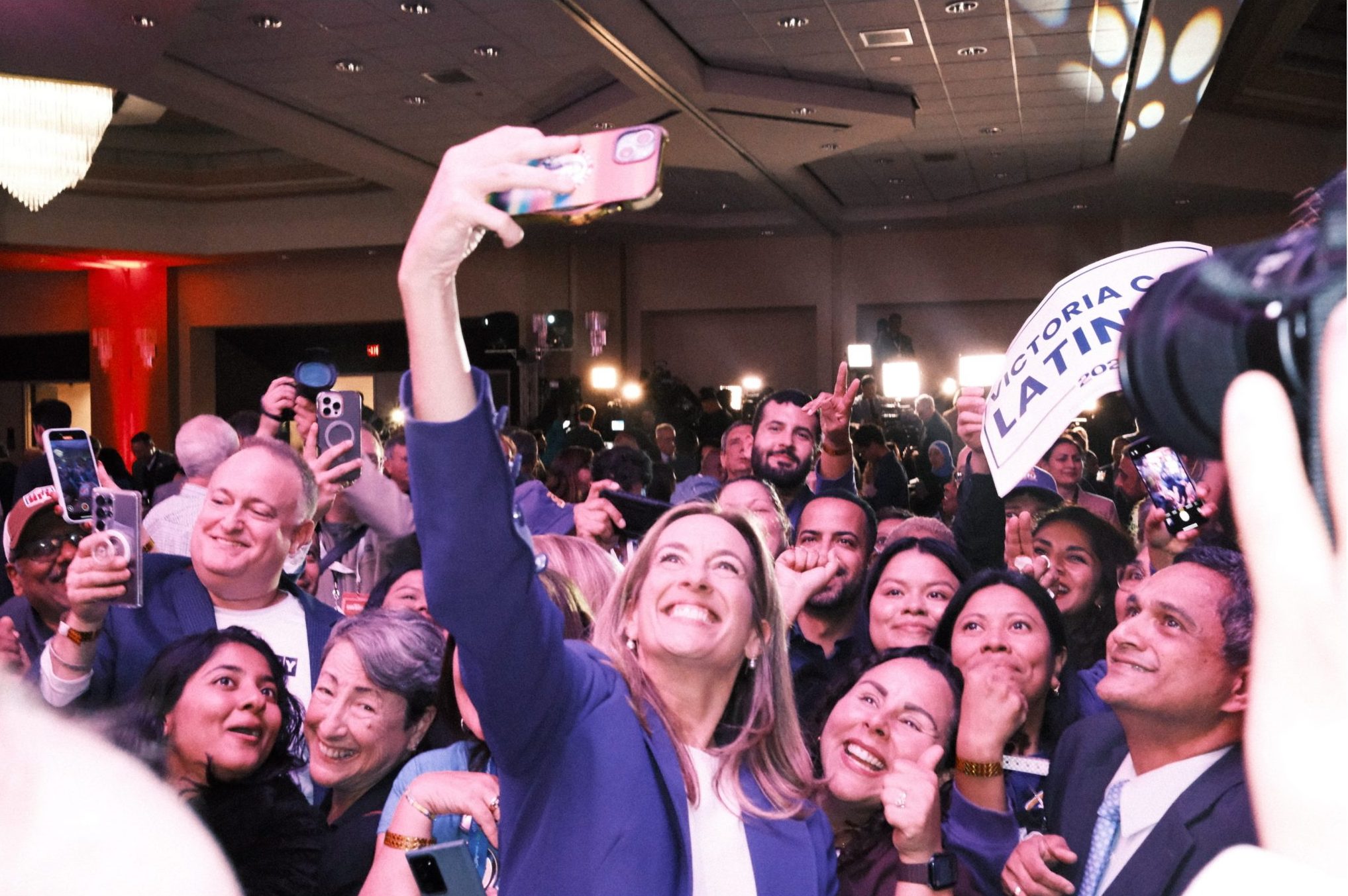
Mikie Sherrill beats Jack Ciattarelli by more than 13 points. Democrats gain as many as five seats in the State Assembly, giving them their largest Assembly majority since the Watergate wave of 1973. Towns across the state that voted for Donald Trump last year, wealthy suburbs and majority-minority cities alike, return to the Democratic column.
The first New Jersey election of the second Trump administration turned out to be the biggest blue wave the state has seen in years. Here are 20 takeaways on what it all means for the New Jersey of today and for the New Jersey to come.
Democrats had a great night. Duh!
Mikie Sherrill: good candidate after all. For years, Democrats and pundits alike had talked up Mikie Sherrill – Navy helicopter pilot, former federal prosecutor, mom – as a dream candidate for statewide office. Then, once Sherrill actually launched a statewide campaign, the sniping began: she wasn’t ready for primetime, she lacked a clear platform, she was letting her opponents get the better of her.
There are valid critiques to be made of Sherrill’s campaign, as there are of any campaign, but the earlier instinct was the correct one. Sherrill was and remains an unusually strong candidate, and poll after poll showed her favorability numbers holding strong even amidst an onslaught of negative advertising. The embrace of her life story is not a crutch; it made voters both like and trust her more, and it earned convincing victories in both primary and general elections that had been seen as highly competitive.
“I never really felt too nervous about my ability to win this one,” Sherrill told Politico after she had won. “The narrative was weird in the primary, and it was weird in the general.”
And Sherrill’s campaign neutralized issues that have sunk Democrats before. After eight years of Democratic Gov. Phil Murphy, it was inevitable that any complaints voters had with state government would be laid at Democrats’ feet. The Ciattarelli campaign honed in on two in particular, high taxes and skyrocketing utility bills, that seemed like they might give the Democratic ticket some serious trouble.
But Sherrill, rather than letting Republicans simply win the messaging war on those issues, went on the offense: she proposed a utility rate freeze, a bold proposal that only sounded bolder when Murphy and Ciattarelli started pooh-poohing it, and she cut selectively edited ads to make it look like Ciattarelli was the one who wanted to raise taxes. A Fox News poll taken shortly before the election found that Sherrill had a nine-point edge over Ciattarelli on taxes and a ten-point edge on energy costs; the days of “if taxes are your issue, we’re probably not your state” are long over.
Jack Ciattarelli ran a good campaign (yes, really). Running with an unpopular Republican in the White House against a Democrat long touted as a stellar recruit was a tough battle, and without Ciattarelli helming the ticket, Republicans might have thrown in the towel long ago.
Instead, Ciattarelli got national Republicans to invest tens of millions of dollars; forced the Sherrill campaign onto its back foot on some issues; and kept everyone thinking the race was close right up to the end. His political career is ending on a whimper rather than a bang, but none of that should be overlooked.
But his Trump alliance doomed him. The Jack Ciattarelli of 2017 was a vocal Trump critic; the Jack Ciattarelli of 2021 kept him at arm’s length; but the Jack Ciattarelli of 2025 professed to be in lockstep with Trump, giving the president an “A” grade during a debate and saying he’s been right about everything.
There were strategic reasons for that, of course: Ciattarelli needed to win a Republican primary, and Trump’s unexpectedly narrow six-point loss in New Jersey last year convinced Republicans that New Jersey wasn’t such an anti-Trump state anymore. But it meant that every time Trump decided to mess with New Jersey voters – by “terminating” the Gateway Tunnel, by trying to suspend SNAP benefits, by cancelling clean-energy grants – Ciattarelli took the fall. New Jersey voters were looking for a way to punish Trump, and Ciattarelli was the nearest warm body.
Even one of the issues that might have been a Ciattarelli winner – questions about Sherrill’s time at the Naval Academy – got botched when the Trump administration improperly released some of Sherrill’s military records, allowed her campaign to turn the story on its head and put Ciattarelli back on the defensive.
Realistically, no Republican was winning in this environment. It’s impossible to know what the ideal campaign strategy was, even with the benefit of hindsight. But one thing is certain: the Democratic wave was national and uncompromising. Even a complete rebuke of Trump would have almost certainly not given Ciattarelli a 14-point swing to victory, especially when such a rebuke would have alienated the MAGA base.
Just look at results elsewhere in the country: a 15-point Democratic win in the Virginia governor’s race, landslides in lower-level state races in Georgia and Pennsylvania, California voters overwhelmingly choosing to gerrymander their own state. None of those are remotely compatible with a Republican win in New Jersey. The New Jersey GOP needs a friendly environment to have a shot at winning – this environment was deadly.
Attempts to isolate New Jersey’s elections from national politics are now wholly dead. New Jersey’s modern founders chose the off-year in an effort to distinguish the state’s politics from national issues. Over the years, though, New Jersey’s elections have increasingly become a referendum on the president elected one year earlier, as seen with the success of Sherrill’s anti-Trump message.
And it’s a two-way street: New Jersey’s election became a top subject of national politics this year, prompting national parties to inundate the state with tens of millions of dollars in search of a key victory between the presidential and midterm years.
A blue wave lifts all boats. Sherrill’s campaign earned her a landslide win, but it also deserves credit for ushering in an enormous Democratic Assembly majority that wouldn’t have been possible without her coattails.
Not only did Democrats win every district that had been seen as competitive, two Democrats landed upsets in districts that Republicans thought they’d hold without much trouble: Marisa Sweeney in the 25th district and Maureen Rowan in the 2nd district (the Rowan race has not yet been called but is likely going in her favor). Sherrill, who won both districts at the top of the ticket, is just as responsible for their victories as Ciattarelli was in 2021 when Ed Durr upset Steve Sweeney.
A few local organizations were able to defy the odds even further: 3rd district Assemblymembers Heather Simmons and Dave Bailey and 30th district Assemblyman Avi Schnall all won re-election in districts that Ciattarelli carried.
Hispanic voters: Democrats once more? Obituaries of the multiracial Democratic coalition written in 2024, after Donald Trump made staggering gains among New Jersey’s Asian American and Hispanic voters, might have to be rethought. Results from Perth Amboy, the state’s most Hispanic municipality: Biden +44 in 2020, Harris +9 last year, Sherrill +56 this year. That kind of enormous swing was replicated in Hispanic and, to a lesser extent, Asian American communities around the state.
Why the shifts? Was it because those voters thought Trump would deliver on his cost-of-living promises and have been disappointed? Because the Trump administration’s deportation policies have struck at the heart of many minority communities? Because Sherrill simply did a better job at community outreach, Spanish-language media, and the like? Both parties will have to do some work to figure it out.
But regardless of the cause, Democrats have reason to be thrilled: the coalition that once delivered them landslide statewide wins is back, at least for now. It’s their job to make sure that 2024 is the anomaly, not 2025.
South Jersey Democrats are back on top, mostly. After Jack Ciattarelli’s coattails helped deliver shocking blows to South Jersey Democrats in 2021, they feared a similar dynamic could repeat itself this year. George Norcross’s South Jersey machine held 21 legislative seats in its 2019 peak, but by 2022, they had fallen to just 12.
But after two good cycles in a row, the South Jersey legislative delegation is back up to 18 seats, with the potential to win even more in 2027, though some Democratic seats remain very vulnerable (and some of the legislators aren’t fully Norcross-aligned). The Democratic Assembly majority will be nearly one-quarter South Jersey, giving Norcross leverage in the new Democratic coalition; Sherrill will have to hope that she has a better start to the South Jersey relationship than Murphy did eight years ago.
The polls were off, again. It’s common knowledge at this point that the polls were pretty far off the mark in 2021, when pollsters put Murphy up by a solid margin only for him to come within three points of losing to Ciattarelli. That result, as well as the surprisingly close 2024 presidential contest in New Jersey (which polls also missed), made Democrats nervous that polls showing a modest Sherrill lead were failing to capture GOP momentum once again.
It turns out that the polls were indeed failing to capture something – just in the opposite direction. Sherrill did better than every poll of the race that was released this fall; the one that came closest was a poll from her super PAC that showed her leading by 12, a result that was mocked as unrealistic when it came out.
A reality of polling that Republicans and Democrats alike should take to heart is that misses happen, and not always in their favor. But pollsters should also do some self-reflection and see if they can figure out why they’ve painted an inaccurate picture of three statewide electorates in a row.
But few could have predicted an electorate this massive. More than 3.2 million New Jerseyans cast ballots in the governor’s race, far outpacing the 2.6 million in 2021 and 2.1 million in 2017. Both parties dumped tens of millions into advertising and get-out-the-vote efforts, and voters clearly listened.
And after years of worries about whether urban and minority voters would turn out in an off-year election, urban areas drove the increase, with cycle-over-cycle turnout in some of the state’s biggest cities increasing by 30% or more. In 2021, about 32,000 Newarkers cast a ballot; this year, more than 44,000 voted. Four years ago, a little less than 17,000 voters in Paterson cast a ballot; this year, more than 24,000 did. In Jersey City and Hoboken, where mayoral races and Hudson County politicking juiced turnout, the number of cast ballots increased 39% and 51% from 2021, respectively.
Pollsters, who rely on electorate projections to balance their polls, would have had a hard time seeing this coming. And the campaigns themselves had to adjust for a massively expanded electorate; the nearly 1.4 million votes Ciattarelli received would have been enough for him to beat Murphy in 2021, but all they got him this year was a double-digit loss.
The amount of money spent this year was unprecedented. As of October 21, $228 million had been spent on this year’s primary and general elections, some spent by the candidates themselves and a lot more spent by outside groups. That total is likely to increase even further once the final two weeks’ worth of spending is accounted for.
The total blows away all prior New Jersey elections, including when self-funders like Jon Corzine, Phil Murphy, and Bob Hugin put millions of their own dollars into their races, and it was spent on what was ultimately a more-than-13-point blowout. New Jersey Republicans could have a hard time convincing GOP groups to open their pocketbooks again in four years.
Campaign finance laws are, politely, a joke. For gubernatorial candidates to qualify for state-funded matching funds, they have to agree to strict reporting requirements and a spending cap, which was set at $8.7 million for this year’s primary election and $18.5 million for the general. These laws help keep New Jersey’s elections transparent and prevent special interest groups or wealthy donors from flooding the state with money.
Ha! Of course they don’t. Barred from funneling money directly into campaigns, outside interests instead simply work through super PACs, which in many cases don’t even have to disclose their donors until after the election is already over. One group, the New Jersey Education Association, spent $45 million all by itself this year to support its leader, Sean Spiller, during the Democratic primary; other unions and party committees spent tens of millions more on their preferred candidates.
Virginia, the other state with a governor’s office up this year, has no limits on how much any one donor can give to a candidate – but candidates there, at least, have to file regular and detailed reports on their fundraising totals and large contributions. Those trying to track PAC spending in New Jersey should be envious.
Republicans should feel nervous heading into 2026 and 2027. In 2026, Republicans will be tasked with unseating Rep. Nellie Pou (D-North Haledon) in a district that voted for Sherrill by nearly 20 points, and defending Rep. Tom Kean Jr. (R-Westfield) in a historically GOP district that may have gone for Sherrill as well. They’ll also have to find someone to make a Hail Mary against Senator Cory Booker.
In 2027, Republicans will have to defend Senate seats in Districts 2, 8, 21, 25, and 30, all of which elected at least one Democratic assemblymember this year; some of those assemblymembers, in fact, might be their party’s Senate nominee in two years. Hundreds of county and local offices will be on the ballot in both years, too.
That’s an ominous position for the GOP to be in, and it sets Democrats up to gain even more ground as the second Trump presidency continues. But Democrats can’t take this year’s wins for granted: 2021 results made Republicans giddy about the prospect of further red waves in 2022 and 2023, but they ended up falling short almost everywhere and even lost some of the seats they had just won.
And longer-term, the state GOP is in need of some new leadership. For the last four years, and arguably before even that, Jack Ciattarelli has been the GOP’s standard-bearer and their great hope for retaking the governorship. That ended on Tuesday, and Republicans don’t have anyone else obviously positioned to take his place.
That’s not to say there aren’t plenty of other people eager and willing to take up the mantle, like State Senator Mike Testa or – some Republicans won’t be as happy about this one – radio host and unsuccessful 2025 candidate Bill Spadea, both of whom are likely thinking about running for governor in 2029. But it’s going to take some time for a state party apparatus that was essentially built around one man to find a new direction.
Assembly Republicans are in a rough spot. Just over two years ago, the GOP had 34 seats and dreams of a majority; now they’re on track to hold just 23 (pending one uncalled race), and will have essentially no ability to stop whatever the Democratic majority wants to do. If Democrats want to take certain actions, like expelling members or pushing bills through on an expedited schedule, their new two-thirds majority could theoretically allow them to do so by themselves.
Assembly Minority Leader John DiMaio won another term as leader, but it’s not surprising that there was some discord within the ranks. For the last four years, Republicans have been unable to prevent their caucus from continually shrinking; they’re heading into January as a nearly irrelevant caucus.
Assembly Democrats have some new headaches of their own. Craig Coughlin can certainly take a victory lap after flipping as many as 11 seats over the last two cycles, but a bigger caucus doesn’t necessarily make his life easier.
At least assemblymembers or members-elect – Ravi Bhalla, Katie Brennan, Andrew Macurdy, Maureen Rowan, Ed Rodriguez, Balvir Singh, Kenyatta Stewart, and Marisa Sweeney – start out as free agents to some extent; most of them won their races without party backing, and few feel especially beholden to anyone in Trenton. (Think of them as the Andy Kims of the legislature.) Lots of others are South Jersey Democrats, a group that typically doesn’t cause Coughlin much trouble but that has distinct incentives and goals of its own.
And in general, more caucus members means more interests to consider, more districts in need of “Christmas Tree” budget items, and more personalities to balance. The Assembly already has a ludicrously large number of committees at 24, but even that won’t be enough to give a chair(wo)manship to everyone who wants one.
Murphy’s legacy will have a (relatively) safe home. Given the seesaw nature of New Jersey’s gubernatorial races, many outgoing executives see their work undone by their successors. That won’t be the case with Sherrill, who has only offered light criticisms of the outgoing governor, saying he should have focused harder on certain issues like energy prices and transparency. Ultimately, Murphy was barely even an issue at all for most of the gubernatorial campaign’s home stretch, a rarity for New Jersey.
Sherrill could always take the state in a more moderate direction, but she’s expressed warmth toward some of Murphy’s key progressive policies, like the Immigrant Trust Directive. The governor-elect also has the option of keeping some of Murphy’s cabinet secretaries and political appointees, a move that would act as a tacit endorsement of Murphy’s governance and legacy.
Now it’s time for the governor-elect to govern. The incoming administration has a cabinet to fill, a government to staff, a state of emergency on utility costs to declare, legislation to write, a president to battle, and, sooner than they might wish, a budget to craft.
Sherrill enters Trenton with a mandate, but she and most of her team have little to no experience in Trenton, and there will inevitably be a learning curve. Congressional offices are no small operation, but an executive role at the helm of a $59 billion budget is a beast of its own. Sherrill will have to do the unflashy day-to-day work of the governor, determine the defining goals of her administration, and deal with the curveballs the Trump administration will inevitably throw her way.
In other words: Mikie Sherrill was elected governor. Now comes the hard part.
