

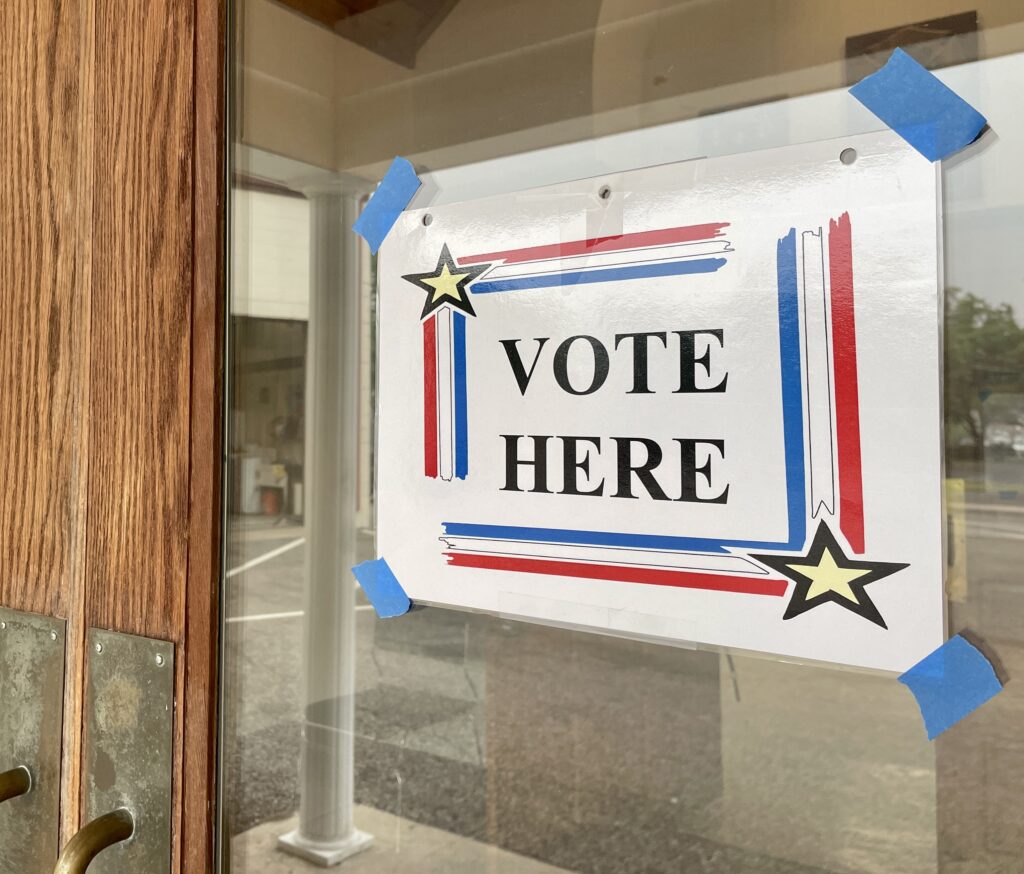
Supporters of a bill limiting federal agents and armed forces at the polls say they’re worried about voter intimidation. (Photo by New Jersey Monitor)
An Assembly panel approved legislation Thursday that would bar federal law enforcement and uniformed military service members from standing within 100 feet of polling places and ballot drop boxes, but a scrubbed vote on the Senate floor could prevent the law from being signed in time for this year’s elections.
The Assembly Oversight, Reform, and Federal Relations Committee approved the bill in a 4-2 vote along party lines, with supporters citing fears of voter intimidation. It would expand an existing prohibition on state and local police at polling places to encompass federal law enforcement and adopt provisions mirroring federal law that bars military personnel at polls that supporters worried would go unenforced under the Trump administration.
“We know that it’s really not a good sign for democracy when you see armed men anywhere near polling sites, not in Myanmar, not in Bangladesh or the Philippines, and not in New Jersey,” said Amber Reed, co-executive director of AAPI New Jersey.
The legislation, introduced just this week, would expand a law signed by former Gov. Phil Murphy in 2022 that barred election officials from requesting police presence at polling places to help maintain peace and good order and limited state and local law enforcement presence at polls to emergencies.
Supporters said the bill is needed because federal officials, including Homeland Security Secretary Markwayne Mullin and President Donald Trump, have declined to rule out deploying federal agents to the polls on Election Day.
Erik Cruz Morales, director of democracy at the League of Women Voters of New Jersey, noted that U.S. Immigration and Customs Enforcement agents appeared at polling places in some states during this year’s primaries and warned that concern over their presence or negative interactions with them could spur some to stay home.
“When voters are unsure whether ICE or federal troops will be at the polls, many weigh that cost and decide it’s not worth the trouble,” he told the committee. “That’s how voter suppression often works today, not through law that blocks the ballot but through enough doubt that people will stay home.”
The bill would also bar federal officials and service members from acting as election board members or as poll watchers — existing law bars police from doing so — though candidates on the ballot can act as challengers regardless of their jobs.
New Jersey’s attorney general would enforce the prohibitions through civil actions for injunctions and restraining orders in state Superior Court.
The legislation contains exceptions allowing individuals to vote and remain within their own residence if it falls within 100 feet of a polling place, and it would create a new exception allowing members of the New Jersey National Guard to come within 100 feet of a polling place or drop box to ensure, at the governor’s direction, access to the same.

Assemblyman Erik Simonsen (R-Cape May), who opposed the bill alongside the panel’s other Republican, offered an amendment that would have required voters to show identification at the polls, but no other member seconded the proposal, and it collapsed after failing to overcome that procedural hurdle.
“I believe if this was part of it, the identification part, there would be less need for anyone to monitor these drop boxes and other places,” said Simonsen.
Assemblyman Avi Schnall (D-Ocean), who chairs the committee and is one of the bill’s prime sponsors, said he did not second the amendment because it could have been the topic of its own hearing.
It’s unclear whether the bill will be law in time for this year’s elections. Though the Senate had planned to move the bill to a floor vote without a committee hearing during Thursday’s voting session, constitutional concerns from within the governor’s office knocked it off that course, said Senate President Nicholas Scutari (D-Union).
“We’re going to work on amendments. We anticipate bringing it up next voting session, but it just — I think perhaps people thought it might have been a little rushed and perhaps it might have not met constitutional muster, so we’re going to make sure,” he told reporters.
Sean Higgins, a spokesperson for Gov. Mikie Sherrill (D), declined to comment.
With the Nov. 3 elections now less than two weeks out, it’s unclear whether the upper chamber will reconvene in time to consider the measure. The Senate has no additional voting sessions scheduled before Election Day, though the full Assembly is slated to meet on Oct. 29.
New Jersey has a history with intimidation at the polls. The Republican National Committee in 1981 deployed off-duty police and sheriff’s officers to polling places in largely nonwhite voting districts.
Tom Kean Sr. (R) defeated Jim Florio (D) by 1,797 votes in the gubernatorial race that year, and Florio in part blamed the so-called Ballot Security Task Force for the Democratic loss. After a lawsuit, the GOP committee entered into a consent decree that admitted no wrongdoing but subjected similar deployments to judicial review. That consent decree lapsed in 2018.
