

The basics:
- NJ cuts permitting backlogs by up to 83% as Sherrill pushes reform
- New public dashboard tracks 10 projects through state agency reviews
- Reforms target delays that raise costs for developers and businesses
- State continues to develop permitting timelines, expand dashboard transparency
Gov. Mikie Sherrill is showing her work, revealing progress on efforts to reign in and reform permitting in New Jersey.
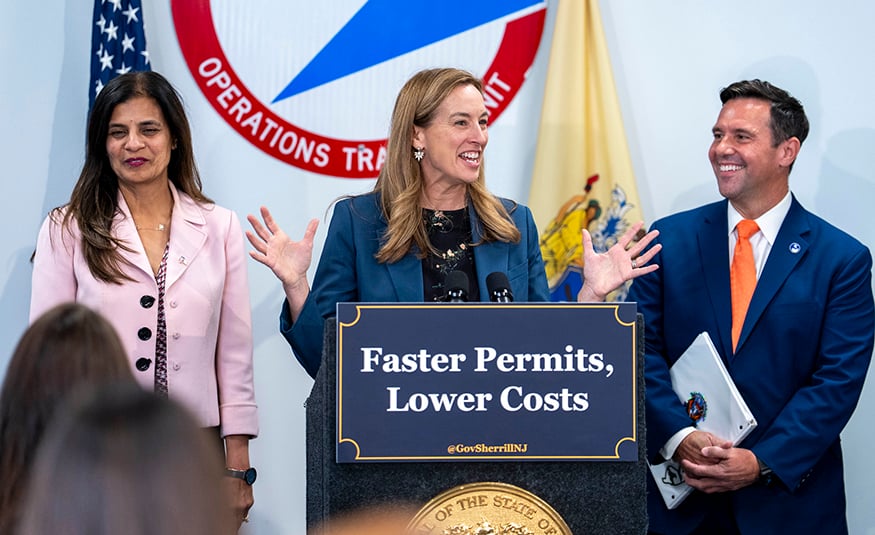
Along with an update on the administration’s efforts to reduce delays and deliver faster reviews, the governor also unveiled the public New Jersey Permitting Dashboard Pilot during an Oct. 28 presentation in Bordentown.
Bearing in mind that “time is money,” the data cited at the New Jersey Department of Transportation’s training facility paint a picture of a changing landscape, which stakeholders say is crucial to retaining and attracting business to the state.
According to the state, since Jan. 20:
- New Jersey Department of Environmental Protection reduced its:
- Freshwater Wetlands Letter of Interpretation backlog by 74%, with applications pending for more than six months falling from 927 to 240
- Remedial Action Permit backlog by 25%, with total pending applications falling from 656 to 493
- NJDOT cut its:
- Minor Access Permit backlog by 83%, including the resolution of 523 stalled permits
- Major Access Permit backlog by 19%, with total pending applications falling from 262 to 211
Permitting dashboard details
Launched in June, the expanded Permitting Dashboard Pilot lets anyone follow 10 pilot projects as they move through review at NJDEP, NJDOT and the Department of Community Affairs. Find it at Permits.NJ.gov.
Each project displays:
- Every permit a project has applied for
- The responsible agency
- Progress throughout the process — from application to completeness review, technical review and final decision, including dates for each milestone
Now, NJDEP and the New Jersey Innovation Authority will work to automate the dashboard to reduce manual data entry as well as allow for the inclusion of additional projects in the coming months, according to the Governor’s Office.
Sherrill has promoted the permitting reform efforts as part of her Saving You Time & Money Agenda.
“Slow permits mean higher costs for everyone, from families waiting on new homes to businesses ready to hire,” she said Wednesday in Burlington County. “In less than a year, we’ve cleared backlogs, changed how agencies work, and moved critical projects forward. And because accountability matters, we’re opening the books so every resident can see the progress for themselves …”
The work began with a concentration on NJDEP Freshwater Wetlands LOIs and NJDOT Minor Access Permits. In the past few months, the state says that effort expanded to tackle the Remedial Action Permit and Major Access Permit. To create effective and timely change, state agencies have reorganized permitting offices and created teams to increase collaboration in processes.
Freshwater Wetlands LOI: Confirms whether wetlands are present on a property and where their boundaries fall. Projects must complete before starting engineering design work
Remedial Action Permit: Necessary for redeveloping previously contaminated Brownfield sites into commercial, industrial or residential properties
Minor Access Permit: Allows small- to medium-sized housing projects and businesses to build or modify driveways and entrances onto state highways, required for many projects statewide to move forward
Major Access Permit: Allows large housing projects and businesses to build or modify driveways and entrances onto state highways, required for many projects statewide to advance
Working FAST
The urgency of the progress is highlighted by NJDEP’s “FAST” work to cut Freshwater Wetlands LOIs.
Now at 74%, about three months ago that figure was 42% following implementation of the department’s Operation Facilitated Approvals for Sustainable Transformation (FAST), according to a June progress report.

NJDEP Commissioner Ed Potosnak said the gains in speed come without weakening the department’s environmental standards. “We are streamlining our processes, hiring new staff to speed up reviews, and modernizing our tech to better serve the public and our stakeholders,” he said.
Meanwhile, NJDOT reorganized to shift all permitting functions under a singular Division of Transportation Permitting and fully digitized its Major Access Permit process.
“We were able to resolve over 500 stalled Minor Access and Highway Occupancy permits by looking at e-permitting data to identify delays and direct additional staff and resources where they were needed most,” said NJDOT Commissioner Priya Jain.
Other initiatives have also helped promote progress. In collaboration with the cross-agency Permitting Governing Council additional steps highlighted by the administration include:
- New hires: Fiscal Year 2027 funding has supported the hiring and onboarding of 49 new staff to expand review capacity at NJDEP
- Process mapping: Used by NJDEP and NJDOT to identify barriers and develop recommendations to reduce costs and delays
- Energy alignment: Establishing a cross-agency working group comprising the New Jersey Board of Public Utilities, NJDEP, the DCA and the Department of Agriculture to align energy project oversight
Real impact
Publicizing this progress is nearly as important as the advances themselves.
During the 3rd Annual Rutgers Center for Real Estate Symposium, which took place a day before the latest disclosures, panelists noted the importance of conveying the change taking place in New Jersey.
Describing Executive Order No. 5 as “terrific” so far, site selection specialist John Boyd Jr. added the results need to be marketed nationally, and beyond, to showcase the state is improving.

“This needs to be promoted just the way we see [Gov.] Josh Shapiro in Pennsylvania,” the principal at Princeton-based corporate site selection consultancy The Boyd Co. Inc. noted. “And you look at Pennsylvania leapfrogging in state business climate rankings because they’re very aggressive on permitting reform.”
Adding that Shapiro has been at it for a year and the Sherrill administration just nine months, Sherrill Senior Director Strategic Initiatives and Economic Development Todd Fisher agreed.
New Jersey slips to 31st in CNBC business rankings
N.J. placed last in the nation for business friendliness and 41st for infrastructure, 39th for cost of living, 38th for cost of doing business and 31st for economy. Get more.
“It’s not just about dashboards and shot clocks. It is about fundamental culture. It’s about change that says we can do both,” said Fisher. “We can protect the environment, protect road safety, etc. And we can do it fast, we can be efficient, we can be transparent, we can be customer oriented. And we have to do both of those things.”
Choose NJ CEO Amy Herbold said that story is due, but “I think we first have to do the work before we get the word out. And you’re hearing it.”
Under the previous administration, Choose NJ expanded globally. Looking ahead, “Choose really wants to focus on relaunching a whole new campaign … And part of that is not just telling stories of all we’re reading right now, the companies leaving,” Herbold explained. “It’s talking about the companies that are here. There’s so many wins that have still been happening that we need to make sure everybody’s aware of.”
Wins like permitting progress are a tool to help keep those companies local.
Next up
Looking ahead, NJDEP is working to reduce its Water Quality Management Program backlog, while NJDOT continues to reduce its Major Access Permitting.
At the same time, DCA is busy mapping the municipal Uniform Construction Code process to identify further improvements, according to the state.

Each agency is in the process of developing shot clock timelines in line with the requirements of EO 5, which will eventually be added to the public view of the permitting dashboard.
Commercial Real Estate Development Association – New Jersey Chapter CEO Dan Kennedy was on hand for the Bordentown announcement.
He described the NJDEP backlog reduction and permitting dashboard as “real-world improvements already making a noticeable impact to the CRE industry.” He said the reorganization and other work at NJDOT should deliver similar results. “By reducing unnecessary delays and uncertainty, these reforms can help move job-creating investments forward by lowering the cost and time required to expand economic opportunity across New Jersey.”
Leaders of both the New Jersey Chamber of Commerce and New Jersey Business & Industry Association also praised the progress.
Calling it an important step toward creating a more business-friendly environment, NJCC President and CEO Tom Bracken said, “A more efficient, transparent and predictable permitting process is essential to making New Jersey more competitive.”
NJBIA President and CEO Michele Siekerka described the permitting dashboard as a “significant step forward in Gov. Sherrill’s efforts to make state government more responsive and accountable to taxpayers.”
The post NJ cuts permitting backlogs, launches public dashboard appeared first on NJBIZ.
