


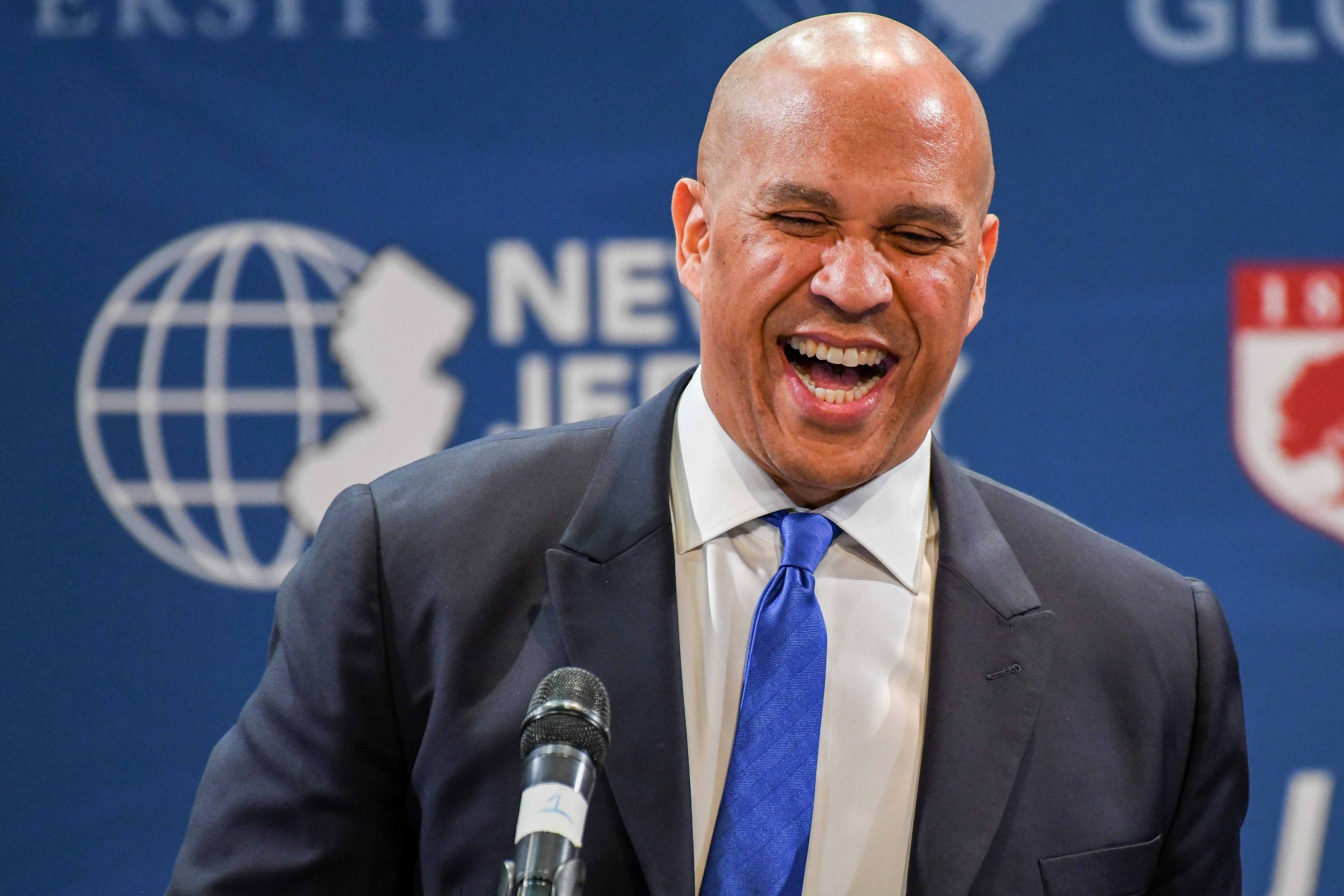
Democratic U.S. Sen. Cory Booker is on track to carry 36 of New Jersey’s 40 legislative districts after his landslide re-election victory over Republican Justin Murphy, a former deputy mayor of Tabernacle, a remarkable showing that could have significant implications for next year’s legislative races — and give him an important talking point as he prepares to seek the Democratic presidential nomination in 2028.
Booker received approximately 62% of the statewide vote, the highest percentage for a Democratic U.S. Senate candidate since Bill Bradley was re-elected with 64% in 1984, and the second-highest Democratic percentage in New Jersey history.
But the most consequential numbers may be in seven legislative districts expected to be among the most competitive in 2027, when all 40 Senate seats and 80 Assembly seats will be on the ballot.
Booker carried all seven of those districts — the 2nd, 3rd, 8th, 21st, 25th, 26th and 39th — by margins ranging from 9 to 27 percentage points.
The numbers are preliminary and unofficial – some counties have not been regularly updated since Tuesday — and results could change before certification, but that’s less likely in the U.S. Senate race.
The results are especially significant in the 21st, 25th, and 26th districts, where Republican senators will be seeking re-election or, in the case of the 26th, where an open seat has created a potentially competitive contest. In last year’s governor’s race, Democrat Mikie Sherrill won all but the 26th.
But the district-by-district results offer an even more revealing look at the political landscape heading into next year’s legislative elections, when all 40 Senate seats and 80 Assembly seats will be on the ballot.
Booker carried the 2nd, 3rd, 8th, 21st, 25th, 26th, and 39th districts by margins ranging from 9 to 27 percentage points, an impressive showing in districts where Republicans will defend incumbents or Democrats will seek to protect seats they won in recent elections.
Still, the numbers demonstrate the breadth of the Democratic wave that swept New Jersey last week, extending beyond traditional Democratic strongholds into suburban communities and historically Republican territory.
Perhaps the most significant results came in three districts represented by prominent Republican senators: the 21st, 25th, and 39th.
In the 21st district, Booker won by roughly 27 percentage points. That is an astonishing margin in a district represented by State Sen. Jon Bramnick (R-Westfield), a moderate and a vocal critic of President Donald Trump.
Bramnick won re-election by seven points in 2023, relying on his appeal to independent voters and Democrats willing to cross party lines. But the district has continued moving toward Democrats, and last year Democratic Assembly candidates Andrew Macurdy and Vincent Kearney defeated Republican incumbents Nancy Muñoz and Michele Matsikoudis.
Gov. Mikie Sherrill also carried the district in 2025.
Bramnick faces a Republican primary challenge from Peapack-Gladstone Councilman Conor Sweeney, a conservative who has criticized Republicans he considers insufficiently loyal to Trump.
Union County Commissioner Kimberly Palmieri-Mouded is seeking the Democratic Senate nomination, while Macurdy has also been considering a bid.
Booker’s 27-point victory illustrates the difficulty facing Republicans who have maintained their political viability through personal popularity even as their districts have become increasingly Democratic.
In the 25th district, Booker is ahead by 16 points, a substantial margin in territory represented by Senate Minority Leader Anthony Bucco.
Bucco has a strong political organization and a family name with deep roots in Morris County politics. His father, the late Anthony R. Bucco, served in the Legislature for more than two decades.
Last week, Democrats won a Morris County commissioner seat for the first time since 1973, another indication that the county’s political landscape is changing.
Booker’s double-digit win in the 25th suggests Democrats could mount a serious challenge to Bucco, although defeating an established legislative leader in an off-year election would require a substantial campaign.
The 39th district, represented by State Sen. Holly Schepisi (R-River Vale), also produced a potentially significant result.
Booker carried the district by 12 points, although the Bergen County numbers are based on a November 5 count. The 39th has traditionally been a Republican stronghold, but changing voting patterns in Bergen County have made it increasingly competitive.
The 26th district may offer Democrats their best chance to capture an open Republican Senate seat. Booker carried the district by 9 points, despite Republicans holding a voter registration advantage. Trump won the district by nine points in 2024, and Republican Jack Ciattarelli carried it by two points in the 2025 gubernatorial election, down from his 14-point victory in 2021.
State Sen. Joseph Pennacchio (R-Montville), a six-term incumbent, announced this week that he will not seek re-election, creating an open Senate seat for the first time in nearly two decades.
Assemblyman Jay Webber (R-Morris Plains), a ten-term incumbent, is seeking the Republican Senate nomination, while Assemblyman Brian Bergen (R-Denville) has said he will remain in the Assembly.
Democratic congressional and county commissioner candidates also carried the 26th district last week, both by approximately seven points.
The combination of an open Senate seat, a potentially contentious Republican primary, and an increasingly competitive electorate could make the 26th one of the state’s marquee legislative races next year.
In South Jersey, Booker’s performance offers another indication of Democratic strength.
He won the 2nd legislative district by almost 20 points, a substantial margin in a district represented by State Sen. Vincent Polistina (R-Egg Harbor Township).
Atlantic County was part of the Democratic wave last week, with Democrats winning countywide offices and reducing the Republican majority on the Board of County Commissioners from 8-1 to 5-4.
Democrat Zachary Mullock, the mayor of Cape May, also defeated four-term Republican Rep. Jeff Van Drew in the 2nd congressional district, which Trump had carried by 13 points in 2024. Mullock won the 1st and 2nd legislative districts.
Polistina has maintained a strong political base and demonstrated an ability to win crossover votes, but Booker’s nearly 20-point victory suggests that Democrats will have an opportunity to make the Senate race competitive.
In the neighboring 3rd district, Booker won by double digits. That district is represented by State Sen. John Burzichelli (D-Paulsboro), who defeated Republican Ed Durr in 2023 to reclaim a Senate seat that Democrats had lost two years earlier.
The 3rd remains one of the state’s most closely watched legislative battlegrounds, with a mix of Democratic communities in Gloucester and Cumberland counties and Republican-leaning areas in Salem County.
Booker’s performance in the 8th district was similarly strong.
He carried the Burlington County-based district by 17.6 points, providing Democrats with another encouraging sign in territory represented by State Sen. Latham Tiver (R-Southampton). The 8th has been a battleground for several election cycles, with both parties investing heavily in legislative campaigns.
Booker’s margin suggests Democrats could enter next year’s Senate contest with a substantial advantage among voters who participated in the federal election, although Republicans have shown they can perform better in legislative races.
Beyond the seven battlegrounds, the results suggest that Democratic gains have reached even deeper into traditionally Republican territory.
In the 24th district, which includes all of Sussex County and parts of Morris and Warren counties, Murphy defeated Booker by just one percentage point.
Trump carried the district by 19.5 points in 2024, Ciattarelli won it by 14 points in 2025, and State Sen. Parker Space (R-Wantage) was re-elected by 28 points in 2023.
Even Sussex County, one of the most Republican counties in New Jersey, gave Murphy a relatively narrow 6-point victory.
The result could encourage Democrats to invest in the 24th, where former Sussex County Freeholder Howard Burrell, the last Democrat to win the county, is preparing to challenge Space next year.
Booker also carried the heavily Republican 30th district by about 3 points, helped by his victory in Lakewood after receiving the endorsement of the Vaad, an influential council of Orthodox Jewish community leaders whose endorsements can carry considerable weight with local voters.
Lakewood has traditionally provided Republicans with enormous margins, making Booker’s victory there especially significant.
In the 13th district, another Republican stronghold, Booker won by a little more than 2 points. The district is represented by State Sen. Declan O’Scanlon (R-Little Silver), a potential 2029 GOP candidate for governor.
Booker also carried the 40th district by 10.5 points, although that figure is based on the incomplete Bergen County count, and the 38th by 23.7 points.
In the 36th, Booker won by 29.2 points, and in the 37th, he prevailed by 44.5 points, also based on the November 5 Bergen County numbers.
Murphy’s strongest legislative district performance came in the 9th, where he won by 12.2 points, and the 10th, where he prevailed by 8.9 points. He also carried the 12th by 3.5 points and currently leads in the 23rd by roughly 2 points.
Those were Murphy’s only four legislative district victories.
Murphy won just five of New Jersey’s 21 counties: Cape May, Ocean, Sussex, Salem, and Warren.
His largest margin was 8.5 points in Cape May, followed by Ocean at 8 points, Sussex at 6 points, Salem at 3 points, and Warren at just 1 point. In New Jersey’s 7th congressional district, Rep.-elect Rebecca Bennett (D-Bridgewater) carried Sussex and Warren counties.
Those are relatively small Republican margins in counties that have historically provided GOP candidates with substantial vote cushions.
Meanwhile, Booker piled up enormous margins in Democratic strongholds, including massive victories in Essex and Hudson.
Republicans also have a history of outperforming their statewide ticket in legislative races, particularly when Democrats are defending the governor’s office or when voters are dissatisfied with the party controlling Trenton. Bramnick, Bucco, Polistina, Tiver, Webber, and Schepisi are not interchangeable with Murphy. They have their own political organizations, campaign resources, and records of winning elections in their districts. But the numbers still present a significant challenge for the GOP.
