

The basics:
- NJEDA has awarded $15M in ART II grants to 39 arts and cultural organizations
- Program has generated more than 1,500 activities
- Union County Performing Arts Center reported more than 31,000 visitors and increased attendance through ART II-funded events
- Grants help organizations build business partnerships, attract audiences, strengthen local economies
A New Jersey Economic Development Authority grant program is encouraging economic activity in communities across the Garden State by leveraging arts and culture as an economic driver and draw. According to Art Pride NJ, the sector brings more than 6.5 million people to cities and towns throughout the state and contributes $692 million to the state’s economy.
The Activation, Revitalization and Transformation program was initially established in Newark and Atlantic City as a $10 million pilot program backed by American Rescue Plan funding. Announced in late 2024, ART II expanded eligibility for the initiative to nonprofits across 31 municipalities. In December 2025, the NJEDA awarded a total of $15 million in grants – exhausting the ARP dollars for ART – to 39 groups.
The NJEDA scored applications to determine the grantees, who could apply for awards ranging from $100,000 to $500,000. Funding was issued at the beginning of 2026. Supported projects must wrap by the end of the year, due to federal ARP guidelines.
As senior advisor for arts & culture at the NJEDA, Barbara Bickart oversees ART II. She described the dollar amounts offered under the program as “unprecedented” for arts and cultural organizations.
For context, applicants for Grants for Arts Projects through the National Endowment for the Arts can request awards ranging from $10,000 to $100,000.
Already highlighting the impact, the NJEDA has tracked more than 1,500 activities stemming from the latest awards.
Arts and culture’s ‘superpower’
In updating ART for its second phase, Bickart said the NJEDA took a double-edged approach. “Leveraging the superpower of arts and culture organizations to do the heavy lifting of economic development … because they do it in such a multifaceted way.
“And what we want them to do with this funding … is to do what they do best: to do more of what they do; to do what they do even better,” Brickart explained.
Because the impact of these groups is not isolated. “When people come out to do arts and cultural activities, they not only participate in the event, for example, they buy the ticket to the theater … and they’re also going out to dinner. And they’re paying for parking, and they’re paying a babysitter, and they’re paying a dog walker, and they’re going out for drinks afterwards. And all of that is money spent in a community,” Brickart said.
When people come out to do arts and cultural activities, they not only participate in the event … they’re also going out to dinner. And they’re paying for parking, and they’re paying a babysitter, and they’re paying a dog walker … And all of that is money spent in a community.
– Barbara Bickart, senior advisor for arts & culture, NJEDA
“That supports small local businesses. It supports the actors in the theater, pays the theater to keep the lights on, and pays for the people who work in the theater. There’s all this sort of residual economic stimulus that happens when arts and culture events happen.”
Packed calendar
The schedule of events and size of organizations participating in ART II covers a wide range.
On one end, there’s Branchburg-based Frontline Arts, for instance, which focuses on inclusive arts experiences in papermaking and printmaking. The funding has enabled the community group to expand its Stages Project – turning veterans’ and healthcare workers’ uniforms into paper – to several new locations. Then on the other hand, there’s the New Jersey Symphony Orchestra, which used its funds to support a composer-in-residence program; or the Riverview Jazz festival in Jersey City, a multiday event that draws about 30,000 attendees.
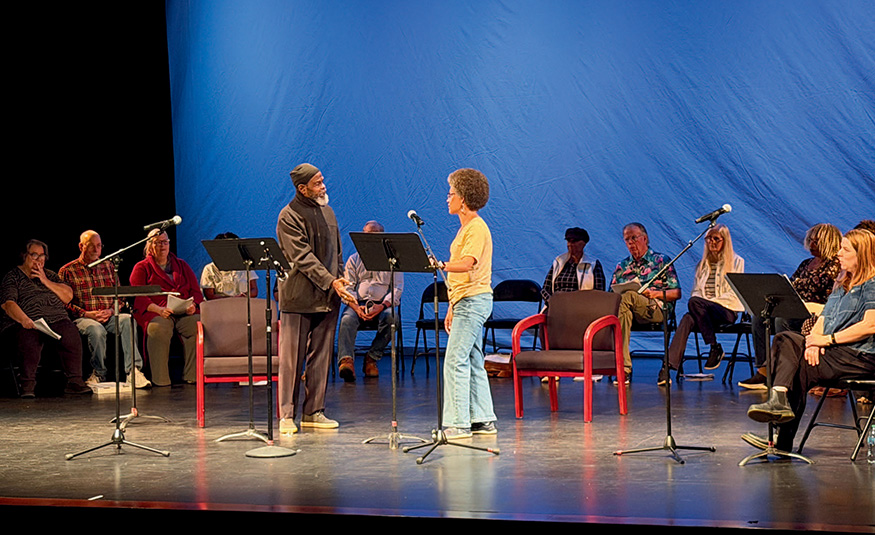
In Rahway, Union County Performing Arts Center – one of the few remaining theaters regularly showing 35 mm film screenings in New Jersey – used the funding in a variety of ways, and to substantial effect.
As of Oct. 30, UCPAC says it sold nearly 12,700 tickets or registrations for 71 events supported by ART II-funded programming. Through the end of the year, the number of sales tops 15,000. Of that, approximately 47% of patrons (excluding rental events) were new to UCPAC.
ART II: Union County Performing Arts Center projects
- 18 screenings of classic family and independent films at affordable ticket prices
- 12 free events to visit UCPAC’s historic venues for arts-concerts, movies, book readings and more
- 10 concerts highlighting jazz, country, rock, R&B and UCPAC’s historic Wurlizter Organ
- 10 free events for seniors, such as workshops, play readings, movies, a book club and peer performances
- 7 summer samp sessions, culminating in a performance or gallery show
- 7 sensory friendly events
- 7 family friendly performances and programs priced for families
- 6 special youth programs, from toddler story time to a high school book club
- 4 free performances for field trips from local schools
- 3 comedy shows
Taking into account those venue rentals, the performing arts center welcomed more than 31,000 visitors since its first NJEDA-supported event March 8, according to the organization.
UCPAC also increased its digital reach on social media. In addition to achieving TikTok verification, its follower counts also went up on Instagram and Facebook.
Built to last
Because the program awarded one-off grants, it was important for the NJEDA to think of other ways to nurture the work for the long term. To do that, Bickart says ART II application scoring incentivized commitments to collaborate. Those partnerships “usually mean you have a better shot at sustaining yourselves going forward,” Bickart said.
In Union County, the performing arts center engaged surrounding restaurants and businesses. That includes featuring 29 local vendors at events, crafting community dinner-and-a-show opportunities with a dozen eateries, and more. The arts center also made a point to look local, teaming up across hotels, transportation providers, catering services, printers, marketing services and promotional items.
UCPAC was also able to reinforce existing relationships. The performing arts center and Wharton arts partnered on a series of free programs thanks to the ART II funding. The Oct. 25 America250-Harmony Across Cultures event featuring the New Jersey Youth Symphony and Special Guests drew a crowd of 1,500 attendees. Meanwhile, on Oct. 28, a school trip drew more than 1,000 local students and teachers for an education concert performed by the youth symphony. The program offered adolescents the opportunity to perform live on the historic main stage as well as featured storytelling, audience participation, and demonstrations by professional musicians and dancers.

The 2026 series concludes with a Gospel Music Festival concert Dec. 12 and New Jersey Youth Symphony’s Two Nutcrackers performance Dec. 13.
Overall, UCPAC said the ART II grant from NJEDA allowed it to host more events, increase tickets sales and attendance and reach new audiences, as well as leverage other funding opportunities.
“[W]ith the credential of having gotten a grant from the New Jersey Economic Development Authority, and this is something that I know from my work,” Bickart, also an artist, said. “But also, this was something that screamed out to us when I got here and we did a request for information to the arts and culture sector … One of the things that came back across the board was, how do we get an EDA grant knowing that that potentially opens other doors for us, other kinds of government funding.”
Beyond ticket sales
To maintain the momentum, UCPAC said it sought feedback to inform new pilot programming and formalized new partnerships.
When it comes to tracking progress for the broader ART II program, Bickart said. “The answer is not tidy … because you’re looking at a number of different things.” While “Economic development is all about, what’s the ROI? … when you’re talking about investment in the arts, it doesn’t get served up in one lump sum.”
She said the NJEDA is evaluating and determining final reporting mechanisms for the program. “The gist of it is, how has the organization been impacted? … How many local businesses were impacted in any ways that you can tell us about that? … How many businesses are you surrounded by? Who do you have partnerships with? Are you able to give us information about the kind of foot traffic and commerce that happened in those local businesses? How many artists or professional artists did you pay?”
The nuance comes in attempting to quantify those tangents. “Not just how many tickets that a theater sells,” Bickart said, “but what does that represent in revenue?… [W]hat does that represent in terms of the number of dollars that are going out the door into local people’s pockets for those jobs?”
A simple equations
At UCPAC, the venue didn’t expand its staff; however, it could “significantly” increase the number of hours available to its current team. “Which in turn created stable employment for our front of house, box office, security, production and tech staff, allowed for more training opportunities, and created a stronger workforce for events,” according to UCPAC’s report.
Projecting the ripple effects over the next five years stemming from the ART II award, UCPAC highlighted the security the funding offered to refine and optimize its work. The performing arts center said some new additions include implementing survey and data collection along with reflecting on how each program fits in with its larger mission.
“As a cornerstone of the Rahway Arts District, UCPAC plays an important role in driving downtown economic activity. The economic impact is simple: When people come to UCPAC, they also support Rahway. They dine at our restaurants, shop at local businesses, and discover everything our downtown has to offer,” said UCPAC Executive Director Danni Newbury.

“Our performances also create paid opportunities for artists, technicians, vendors, and other professionals,” she continued. “By supporting accessible programming that attracts new audiences, NJEDA’s investment helps turn cultural experiences into economic opportunities for our entire downtown business community.
“Each event creates the potential for additional spending, increased foot traffic, and repeat visits to Rahway.”
With ART II events, projects and programming are still coming down the pike. As the calendar runs out on 2026, Bickart said the priority is highlighting the ways in which these grants make arts accessible and continue to drive economic impact — besides offering something beautiful.
“That’s unique about the way that we do this work, is we are interested in funding things – and did through this program – that are not about this is the most amazing fine art,” Bickart said. “But rather, how many people is this work going to touch? How is it going to lift?”
