


[This story was originally published by South Jersey Climate News through the NJ News Wire.]
As the sun sets across South Jersey, darkness does not always follow.
Streetlights illuminate residential neighborhoods, shopping centers remain lit after businesses close, and large commercial properties can cast light into the surrounding landscape throughout the night.
In Gloucester County, the changing landscape can be seen along Route 322, a corridor that passes through communities that have historically included rural and agricultural areas.
At Route 322 and Locke Avenue in Woolwich Township, for example, a 154-acre logistics development brought plans for three warehouse buildings totaling nearly 1.2 million square feet. Farther east in Harrison Township’s Richwood section, another proposal near the Route 322 and Route 55 interchange has included plans for 10 warehouses as part of the 385-acre development.
This type of development can also change what these areas look like after dark.New roads, parking lots, warehouses, and other commercial properties often require outdoor lighting, introducing artificial light into areas that may have previously been darker at night.
As development continues in parts of South Jersey, this phenomenon raises another question: What does a brighter nighttime environment mean for insects that depend on darkness?
For Daniel Duran, an assistant professor of environmental science and naturalist at Rowan University who studies insects and biodiversity, artificial lighting is one of several environmental pressures that can affect insects.
“There’s pesticides. There’s a lot of natural areas, forests and fields that are now housing developments or agriculture,” Duran said. “All of these things contribute. It’s like a one, two, three, four punch.”
Although Duran said he has noticed what appears to be a decline in insects across New Jersey, he cautioned that his observations are anecdotal and that declines cannot be attributed to artificial lighting alone.
Scientists studying artificial light at night (ALAN), have found evidence that nighttime lighting can alter the behavior of insects, including moths and other nocturnal pollinators. The issue could extend beyond insects themselves because moths serve as pollinators and provide food for birds, bats, and other animals.
Moths provide one of the most familiar examples of insects interacting with artificial light. Anyone who has watched moths gather around a porch light has seen the phenomenon, but the reasons behind that behavior involve how moths navigate at night.
Yahel Ben-Zvi, a postdoctoral researcher in the Department of Entomology at Rutgers University who studies beneficial insects, explained the behavior in a July 2026 article by the New Jersey Agricultural Experiment Station.
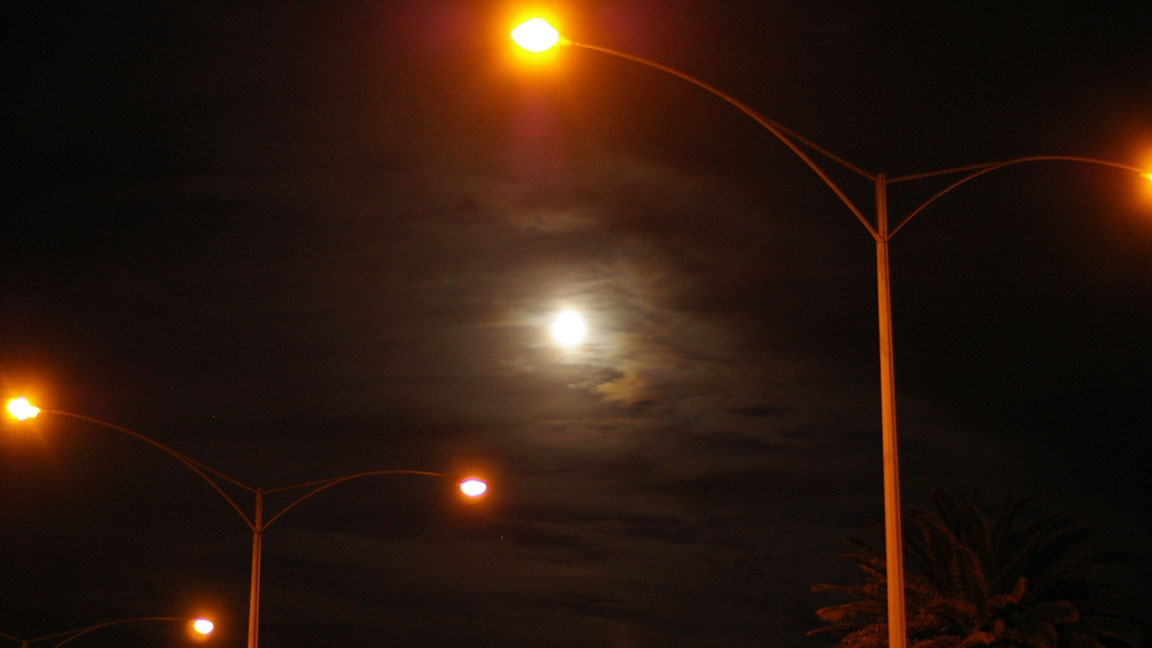
“When flying at night, moths use the light of the moon and stars to help them navigate,” Ben-Zvi said. ““Artificial lights confuse those navigational cues, which is why they often end up flying toward porch lights and streetlights.”
Duran also explained that many insects use the moon to help navigate, keeping it a particular angle while flying. Unlike the moon, however, artificial lights are close enough for insects to approach and circle, sometimes causing them to collide with the light or nearby surfaces.
“It can physically damage them when they do this,” Duran said. “It makes them sitting ducks for all kinds of predators because now they’re not where they’re supposed to be and they’re all concentrated near a light source.”
He said predators such as toads can take advantage of insects gathering around outdoor lights. Artificial lighting can also interfere with mating, as insects become disoriented or exhausted rather than continuing their normal nighttime activities.
“It’s going to really impact their ability to find a mate and successfully mate,” Duran said.
Research has also documented other behavior effects. A 2018 study of artificial light and nocturnal insects examined how nighttime lighting can affect insect behavior, including attraction and disorientation. Other research has found moths exposed to artificial light spent less time feeding than moths kept in darkness.
The effects are also not limited to moths. Research on artificial light at night has examined impacts across nocturnal and crepuscular insects, including beetles, flies, and other groups. Bioluminescent insects such as fireflies may face an additional problem because artificial light can interfere with a communication system that depends on light.
The potential consequences of nighttime lighting also extend beyond moths themselves. Insects provide food for birds, amphibians, fish, and other animals, while many species also play important roles in pollination.
“They are food for pretty much every single thing that you can imagine, including birds, other types of insects, frogs, salamanders, fish,” Duran said.
A 2017 field experiment published in Nature compared plant-pollinator communities in Switzerland exposed to artificial nighttime lighting with communities that remained dark. Researchers found that nocturnal visits to plants were 62% lower in illuminated areas. The focal plant studied also experienced a 13% reduction in fruit production despite receiving visits from daytime pollinators. While the research was conducted in Switzerland, it provides insights that artificial lighting can disrupt interactions between nighttime insects and plants.
Fireflies face a different problem because they rely on their own light to communicate. At least 80% of firefly species found in the United States and Canada use bioluminescent flashes, flickers, or glows to communicate, according to the Xerces Society for Invertebrate Conservation. Because these species are active around dusk or after dark, artificial lighting can make it more difficult for them to see each other’s signals.
Estimating the firefly population is difficult due to sampling challenges, although “anecdotal reports and expert opinion also suggest reductions in both the occurrence and abundance of many firefly species over recent decades,” according to a 2020 study of the firefly population. The scientists cited habitat loss, artificial light, and pesticide use as the three most serious threats to the firefly population.
New Jersey’s own guidance for warehouse development acknowledges nighttime lighting as an issue. The State Planning Commission’s Warehouse Siting Guidance recommends reducing light pollution and glare “to the maximum extent possible.” It recommends that warehouses consider site-wide lighting programs consistent with International Dark Sky Association standards when possible.
The guidance also recommends motion sensors that can turn lights off or dim exterior lighting to between 25% and 50% output after sunset when no motion has been detected for 10 minutes. Other recommendations include directing facility lighting toward the interior of a site and using full cut-off shield or anti-glare lighting.
Duran said measures that reduce the amount of unnecessary light reaching insects could help limit their exposure.
“Having unidirectional lights, having lights dimmed when they’re not needed to be bright, all these things are really important,” he said.
He also emphasized that the type of light matters. Duran said amber, yellow, and other warmer-colored lighting tends to attract fewer insects than some brighter white or bluish lights.
A 2022 review in the Annual Review of Environmental and Resources noted that LEDs commonly used for outdoor lighting can emit strongly at blue wavelengths, to which many biological responses are particularly sensitive.
“I’m hoping that they’ll use certain types of ones that have more of an amber or yellow tone than a bright white or bluish tone,” Duran said. “This is fairly easy to do. Switch bulbs from the ones that are attracting insects to the ones that don’t attract insects.”
The Xerces Society’s firefly-friendly lighting recommendations encourage reducing unnecessary nighttime lighting and considering how outdoor lighting affects firefly habitat. For Duran, reducing potential harm does not necessarily require complicated changes. He said choosing lighting that attracts fewer insects is one practical step communities can take.
Along Route 322, and elsewhere in South Jersey, development will continue to change the daytime landscape.
What remains less understood locally is how much that development is also changing the landscape after sunset, and what those changes mean for the insects whose lives begin when daylight ends.
