

The basics:
- SJTA broke ground on $400 million project to widen the Atlantic City Expressway
- Three-phase project will add third lane in each direction between mileposts 31.6 and 44.2
- Construction expected to begin in 2027; phase one projected to take nearly two years
- Project aims to ease summer traffic congestion, improve roadway safety, support regional mobility.
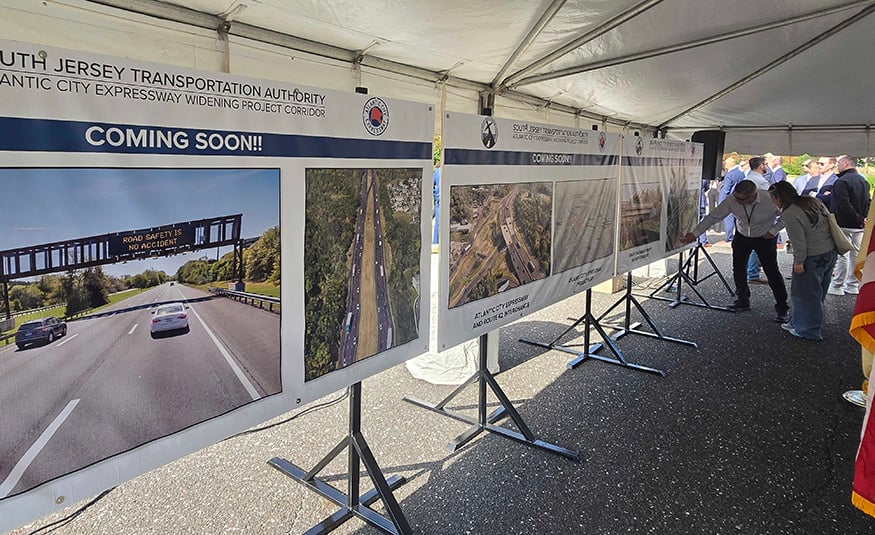
The South Jersey Transportation Authority broke ground this week on the beginning of a three-phase project to expand the Atlantic City Expressway to three lanes.
SJTA Executive Director Stephen Dougherty; U.S. Rep. Donald Norcross, D-N.J.; SJTA Vice Chair Barbara Holcomb and others were in attendance to celebrate this $400 million project.
“This project, without a doubt, is a significant investment to one of South Jersey’s most important transportation asset,” said Holcomb. “A project of this magnitude doesn’t happen overnight. It requires years of planning, engineering coordination, financial management and problem solving.”
Norcross told NJBIZ that while $400 million is necessary for this type of work, which he believes should have been done 10 years ago, the return on investment will go right back to those who use the roads.
“The interesting part about this, this is funded through tolls, not through direct revenue through the state. There is some additional money, but not significant amounts of the people who use it are paying for it directly. That’s a direct return to those who use it,” Norcross said.
The road ahead
The project will create a third lane for both sides of the ACE. It will begin at milepost 31.6 and will run through milepost to the western terminus of State Highway 42’s milepost 44.2.
“Today, we are officially beginning the next major chapter in the history of our road. The Atlantic City Expressway has been connecting South Jersey for more than 60 years. It connects our communities, it brings visitors to Atlantic City and the Jersey Shore,” said Dougherty. “It carries people to work, it connects businesses, customers and supports tourism commerce and economic activity throughout this region.”
According to the ACE widening project overview, the need has become crucial to help alleviate congestion, especially during the summer travel periods, which has experienced an excessively high number of car accidents.
Traffic talk
Dougherty told NJBIZ that construction is expected to begin in 2027. And commuters shouldn’t see disruption in the flow of traffic.
“We’re always adjusting the construction schedule around what our traffic looks like. So, when there’s peak season of what we historically say are 100 days of summer, Memorial Day to Labor Day, there’s certain construction we wouldn’t do, because we don’t want it to impact the traffic,” Dougherty said. “Our goal – and we think this is highly attainable – that we’ll have two lanes open in operational in each direction through the entirety of the project.”

While he said that phase one of this project will most likely take almost two years to complete, the goal is to get it done sooner.
“Obviously, we want to meet our commitment of having it break ground to fully operational on a schedule that we think we can meet if there’s opportunities where we can still operate it efficiently and safely, and there’s opportunity for us to advance some work,” Dougherty said. “We just don’t want to impact the customer who’s driving the road, whether it’s part of our commuters or your vacationers, long weekenders, or day trippers.”
The goals and objectives of the ACE widening project are to:
- Mitigate summer traffic congestion along the corridor and increase mobility in the South Jersey and Philadelphia Region
- Increase coastal resilience in the region
- Create a safe corridor for ACE users
- Provide enhanced accommodation for emergency evacuation purposes
- Eliminate as many existing substandard geometric features as possible and update roadway to the latest standards where practical
- Improve the quality of life for residents and businesses along the ACE corridor and the feeder roadway network, particularly during summer months
- Improve access to employment by improving mobility
- Support efforts to increase the economic competitiveness of the Philadelphia and South Jersey region
- Reduce air and noise pollution resulting from summer traffic congestion along the corridor
- Avoid and minimize adverse impacts to sensitive environmental and cultural resources
- Implement a cost-effective and financially feasible alternative
The post SJTA breaks ground on $400M Atlantic City Expressway widening project appeared first on NJBIZ.
