

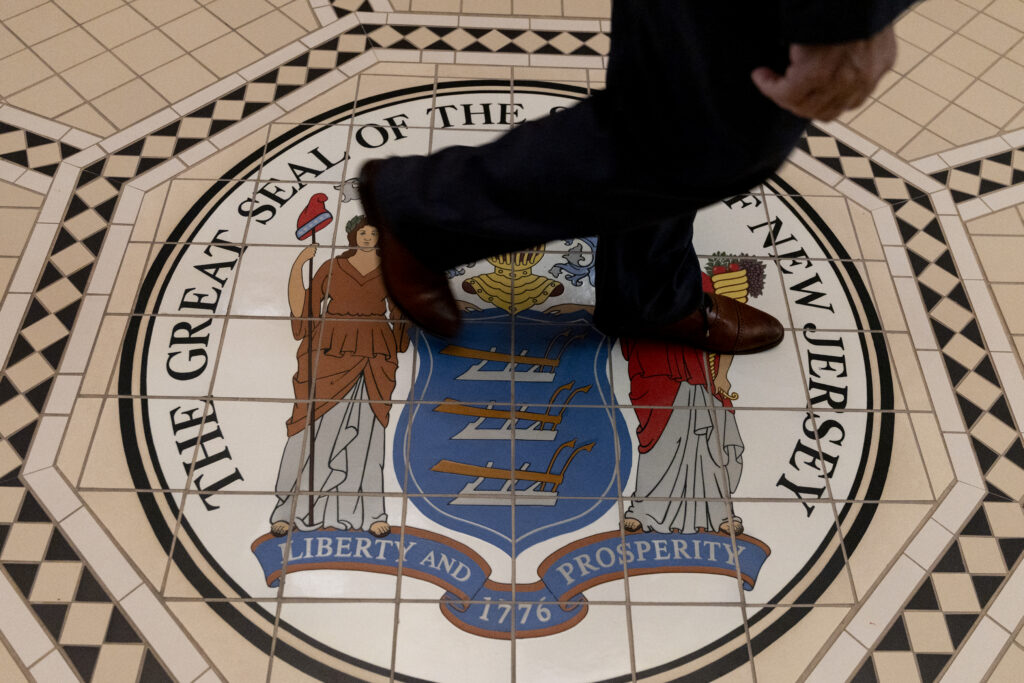
Assembly lawmakers considered a four-bill package Monday that would implement various regulations on AI. Business groups warned of overreach. (Photo by Anne-Marie Caruso/New Jersey Monitor)
Business groups urged New Jersey lawmakers Monday to avoid erecting regulations on artificial intelligence over fear of creating patchwork enforcement, while AI safety experts and others want the state to adopt strong safeguards amid federal inaction on the issue.
The discussion before the Assembly Science, Innovation, and Technology Committee could help determine how closely New Jersey follows other states, like New York and California, that have enacted more stringent AI regulations, and whether the state will allow large AI firms to escape liability for harms their technology causes, as some industry officials urged Monday.
Large model creators like Meta and Anthropic should be shielded from liability for harms spurred by a user because those firms could test their products but would be unable to prepare for every possible instance of abuse, said Matt Lenz, public policy director for Meta.
“We go through an exhaustive list to make sure that the models we release are safe and won’t cause any catastrophic harm. I don’t think we can predict use cases of everything, but making sure that that liability is on the appropriate downstream user so that we can still release open source models, I think, is really important,” he said.
AI safety has become an increasing focus for lawmakers after numerous AI researchers at industry-leading firms raised concerns about the technology.
Recent incidents like Hugging Face — where AI agents run by OpenAI broke free of their training environment and hacked Hugging Face, an unrelated AI firm — have redoubled legislators’ concern that the industry cannot safeguard its own technology.
Some witnesses told the committee that while AI represents a tectonic shift in computation and capability, it is still a man-made product that could be regulated the same as any other.
“We should start with the baseline principle that these are human-engineered products. We have human ways to control it, and if they’re not appropriately responding to our human-level controls, that’s a problem on whoever’s deploying the product,” said Mihir Kshirsagar, director of Princeton University’s Tech Policy Clinic. “It shouldn’t be the problem for society to then adapt to whatever that reality is.”
The panel discussed, without votes, four bills that would place limits on artificial intelligence or give residents new rights that could limit its use.
One bill would give New Jerseyans an exclusive property right over their name, image, likeness, and voice and would allow them to enforce that right through a civil action for damages and attorney fees. Violations of that right would also be prosecutable as disorderly persons offenses.
Jack Ramirez, a lobbyist for the New Jersey Business and Industry Association, warned that allowing individuals to recover attorney fees in this area would prompt a surge of lawsuits. The proposed criminal penalties are unusual, and firms should be provided an opportunity to remove offending content before facing legal liability, he said.
A separate bill would require disclaimers on AI-generated content in plain English and as computer-generated marks that could be used to verify a file was generated by AI.
“One of the biggest challenges our country faces is the proliferation of artificial digital objects created by artificial digital intelligence and the ability to understand if something’s real or not,” said Rob Eleveld, founder of the Transparency Coalition, which lobbies for AI safety regulations.
Ramirez warned that the bill’s fines, set at $5,000 per violation per day, would be too much for small and mid-sized AI firms to bear. He raised similar concerns over a separate bill that would make generative AI platforms civilly liable if their products are used to further a crime or create child sexual abuse material.
That measure would allow firms to make an affirmative defense that they made “reasonable efforts” to prevent their product from being used for a prohibited purpose. Ramirez said lawmakers should be clear on what qualifies as reasonable effort and again warned steep fines could bankrupt smaller AI companies or push some products out of New Jersey altogether.
One of the biggest challenges our country faces is the proliferation of artificial digital objects created by artificial digital intelligence and the ability to understand if something’s real or not.
– Rob Eleveld, founder of the Transparency Coalition
Assemblyman Andrew Macurdy (D-Union), who is sponsoring the four-bill package, argued fines need to be large to affect the behavior of AI behemoths like Anthropic, which is valued at close to $1 trillion.
The final bill in the package would require large AI developers to disclose their safety procedures for frontier models to the New Jersey attorney general. It would also allow the attorney general to audit large AI firms both directly and through contracts with private entities.
Witnesses said strong oversight of the most cutting-edge models is needed even if those models are still in testing phases. They urged lawmakers to take steps to prevent regulatory capture, a phenomenon where firms effectively control their regulators, including by making regulators dependent on the companies they oversee.
“We’ve known from any number of places that we don’t want to trust someone to grade their own homework,” said Kshirsagar. “On the other hand, if you don’t actually empower anybody else to do it, then you’re going to get a set of captured entities that go out and do that work.”
