

The basics:
- NJBIZ panelist discuss healthcare trends, such as as staff shortages
- Healthcare education programs aim to build the future workforce
- AI offers efficiencies but raises cybersecurity concerns
- Telehealth and community-based care can expand patient access
As part of NJBIZ’s latest virtual discussion, industry professionals from New Jersey-based organizations assessed the ever-changing landscape of the medical field and what to expect in the future.
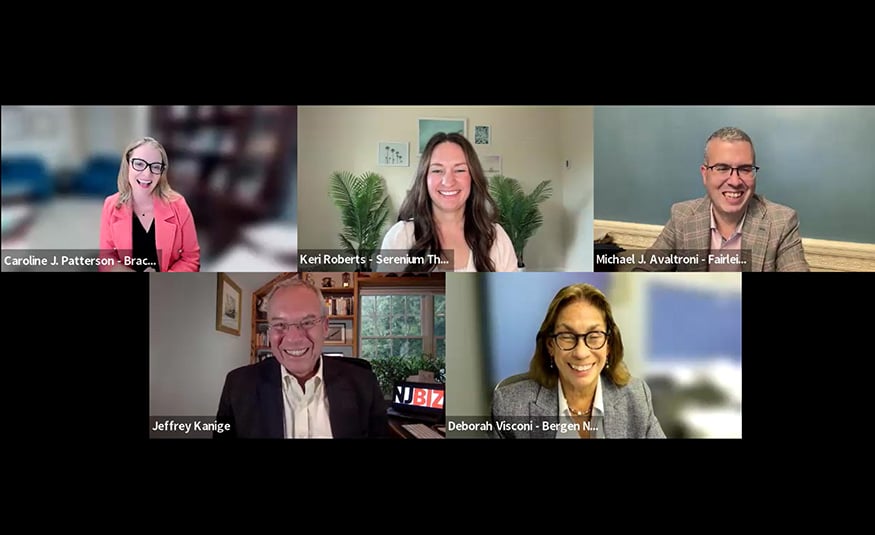
Moderated by NJBIZ Editor Jeffrey Kanige, the Sept. 30 panel featured:
- Michael Avaltroni, president of Fairleigh Dickinson University
- Caroline Patterson, a healthcare attorney and the vice chair of the Healthcare Law Department at Brach Eichler
- Keri Roberts, director of strategic partnerships and communications at Serenium Therapy and Wellness
- Deborah Visconi, president and CEO of Bergen New Bridge Medical Center
During the 90-minute event, the expert panelists discussed the different ways the medical landscape has changed over the years and the adaption into modern times with patient care and technology.
The speakers also dove into the shortage of doctors and nurses, artificial intelligence use in medical offices, prevention of burnout in nurses and others, needed positions and how they can help private practices attract more help.
Growing concern
The shortages of nurses, doctors and other vital positions aren’t new to the medical field but with expected retirements and workforce needs, the efforts to fill positions could become harder.
Avaltroni said the situation isn’t going to improve easily. “It’s not going to be solved by saying, well, we just need to find more nurses. We know that there are shortages, and frankly, with retirements of the sort of baby boom generation, that number is going to go the wrong way, not the right way,” Avaltroni said.
According to the 2026 New Jersey Nursing Data & Analysis Report from the New Jersey Collaborating Center for Nursing, the state will need to expand its registered-nurse workforce from 96,037 RNs in 2024 to 102,476 by 2034 with a turnover rate of 31%.
“We just can’t keep up because the shortages are so acute, but we, for example, have seen our nursing enrollments over the past five years more than double,” Avaltroni said.
We can’t keep designing healthcare jobs the way we did 20 years ago. We have to design jobs and environments that are going to attract the new workforce.
– Deborah Visconi, president and CEO, Bergen New Bridge Medical Center
Visconi added that shortages are not limited to nursing. “We certainly do have shortages, and not just nurses and doctors, but we’re seeing some shortages in some of the technical fields, like in imaging and even physician’s assistants or nurse practitioners,” Visconi said. “Even in the trades, quite frankly, we’re seeing shortages across the board.”
She does believe the key to recruiting the new workforce starts with the environment itself. “We can’t keep designing healthcare jobs the way we did 20 years ago. We have to design jobs and environments that are going to attract the new workforce,” Visconi said.
Private practices
The workforce shortage hasn’t just affected the big names in the medical fields. Private practices across the state are experiencing their own struggles with filling vacancies.
“We’re seeing a lot of practices lean into and increase their workforce on the ancillary providers. In addition to the budgetary constraints we’re talking about, there’s a physician shortage,” Patterson said. “The physician community struggles very much with how much they want scope of practice to change, and how much they need ancillary providers. Ancillary providers are really becoming a big key to having a functioning and healthy medical practice.”
Patterson has seen these practices take steps to try to meet the needs they have. “I do see heavy efforts in trying to recruit physicians, because that’s a big, a big issue that they’re facing, and we’ll get into workforce challenges, but I think in particular, I’m seeing a lot of challenges with providers trying to get young physicians to come and work for their practices. There’s a lot of opportunities, a lot of competition, and a lot of other places that they can go,” Patterson said.
Ancillary providers are really becoming a big key to having a functioning and healthy medical practice.
– Caroline Patterson, healthcare attorney, Brach Eichler
As the medical field has changed, so has the business model.
“And the traditional small medical practice model has changed quite a bit now that we have private equity on the scene, institutional work — things like that. The younger doctors don’t necessarily want to come up and run a practice,” Patterson said. “So that’s really where they’re focusing, I would say, on their recruiting, and then really keeping a lot of ancillary providers in place and happy and just trying to really be strategic about that.”
Replay: Trends in Healthcare
Click through to watch the full panel discussion!
It starts with education
“We need to start thinking about building the workforce of the future. One of the things we’re doing is creating, sort of, a footprint as an institute of emerging health professions,” Avaltroni said.
According to Avaltroni, that looks like, “Thinking about what are the needs out there to provide greater access to care for more people? And how do we make sure that we’re training appropriately those individuals who can, frankly, be the ones that stand in the gap in some cases to provide access and to extend access?”
We need to start thinking about building the workforce of the future.
– Michael Avaltroni, president, Fairleigh Dickinson University
He believes there are also pathways that students can take before they get to college to begin learning and help create a passion for this work. “We’ve built, for example, partnerships with high schools to start beginning, essentially, kind of a pre-college training program where students, through their high school training and some CTE programs that we partner with, actually begin to pursue some type of an allied health pathway where they get a certification when they leave high school.”

A few other options would be a “learn as you earn” avenue where students can make money and get hands on experience. In fact, Avaltroni has begun communications with two-year colleges to help make a more affordable pathway for students to walk this path.
At the end of the day, the education system needs to not only make sure it listens to health providers and the needs they have, but also ensure its students, whether nurses, physicians or other skilled medical trades, are ready to go on day one.
Tech savvy
In the ever-changing landscape of medical technology, the road makes it clear that you need to catch up or get left behind.
Avaltroni considers teaching that “AI isn’t a tool for replacement but rather enhancement.”
“The analogy I always use is, if you’ve been into a physician’s office where they’re using ambient listening technology. That’s a perfect example of AI, how it’s intended to be used as an extender, right?” Avaltroni said. “Rather than a physician or a PA or a nurse with their head buried in a computer trying to take copious notes.”
But Patterson also warns of the dangers of using AI and its adoption.
“I think with patients’ data, cybersecurity is one of the biggest issues that we’re going to be facing as all these technological improvements come about, and you see them all the time in the news. It’s a big risk,” Patterson said.
Burnout in the workplace
Most people will experience burnout when it comes to their job. Often, it is due to workload, stress, emotional strain and sometimes lack of an overall workplace support system.
Roberts believes alleviating those strains starts with identifying the stressors and creating ways to deal with them. “Our clinical director saw this happening, and so beyond the supervision once a week, she created a peer program. So now any of our new clinicians, whether they’re green to the industry or not, has an opportunity to work with a second person who’s been in the industry and or with us for a long time, and to have that kind of second person,” Roberts said.
At the end of the day, she notes, everyone is human. “So, I think the more that we can, you know, they’re humans too, right? I think people think therapists are, you know, they don’t have emotions, or they’re dealing, but they’re dealing with heavy stuff all day, and they have their own stuff,” Roberts said.
Get people aware … that mental health is health, that it’s important, understanding that you can come to it if you feel stressed.
– Keri Roberts, director of strategic partnerships and communications, Serenium Therapy and Wellness
But how do these young nurses, doctors and other professionals cope with some of the burnout and mental side of it? “It’s interesting because sometimes they get a little nervous at first and imposter syndrome, and then they do it and they feel proud of themselves and excited. And then it inspires their peers of, ‘Hey, I would love to do that,’ or ‘Can I make a video? Can I do something?’” Roberts said.

The mental side of health is just important as taking care of your physical body.
“Get people aware – for us specifically in mental health – that mental health is health, that it’s important, understanding that you can come to it if you feel stressed,” Roberts said.
According to the Substance Abuse and Mental Health Services Administration, 722 people in New Jersey for the year 2025 were admitted into a psychiatric hospital with about 1,742 people in total treated in that year.
“What are elements of health, so that you’re not ending up in a crisis situation in a hospital that is already overwhelmed? So, we really look at partnerships. Again, how do we expand that access to care? How do we help the organizations around us; and help patients understand what area they should be in and who they can turn to?” Roberts said.
Meeting patients where they are
One advancement in the mental health field Roberts spoke highly of is telehealth and being able to meet patients where they are. “I think when we talk about, again, access to care, that’s what virtual healthcare has done. You know, if we don’t have a location nearby, obviously in more rural communities … they’re not going to drive an hour and a half. Or again, if the hospital doesn’t have the outpatient (treatment) that they need, we are able to do that virtually. So that has always been helpful,” Roberts said.
“We view our role in the community as that beacon of health and hope and healing for those that need it. Need us and we believe that we need to go to the people,” Visconi said.
Bergen New Bridge Medical Center began meeting patient care by opening practices inside ShopRite supermarkets.
Don’t miss this:
Bergen New Bridge Medical Center broke ground Oct. 7 on a new facility designed to support families across generations. Find out more here.
“If you’re going to go out to buy food, if you have one time to go out of your house, because you’re caring for a child or an elder, and you’re going to go buy food,” Visconi said. “You can take your child or yourself to the primary care doctor that’s right there in ShopRite. And so that has been an adventure that we put out and is working really well. The people love it.”
Other issues outside of patient accessibility come with the elderly, post-discharge instructions, and making sure those who need care can not only get it but afford it.
Avaltroni believes that meeting these patients’ needs locally will help take some load off of hospitals and emergency rooms.
“You should have access to community-based resources around all of that, and it will also, in doing that, open the doors to get people a lot more access, but also then take a lot more burden off of the already taxed emergency department, or the already taxed physician systems that we have,” Avaltroni said.
The post NJ healthcare leaders tackle workforce, AI challenges appeared first on NJBIZ.
