

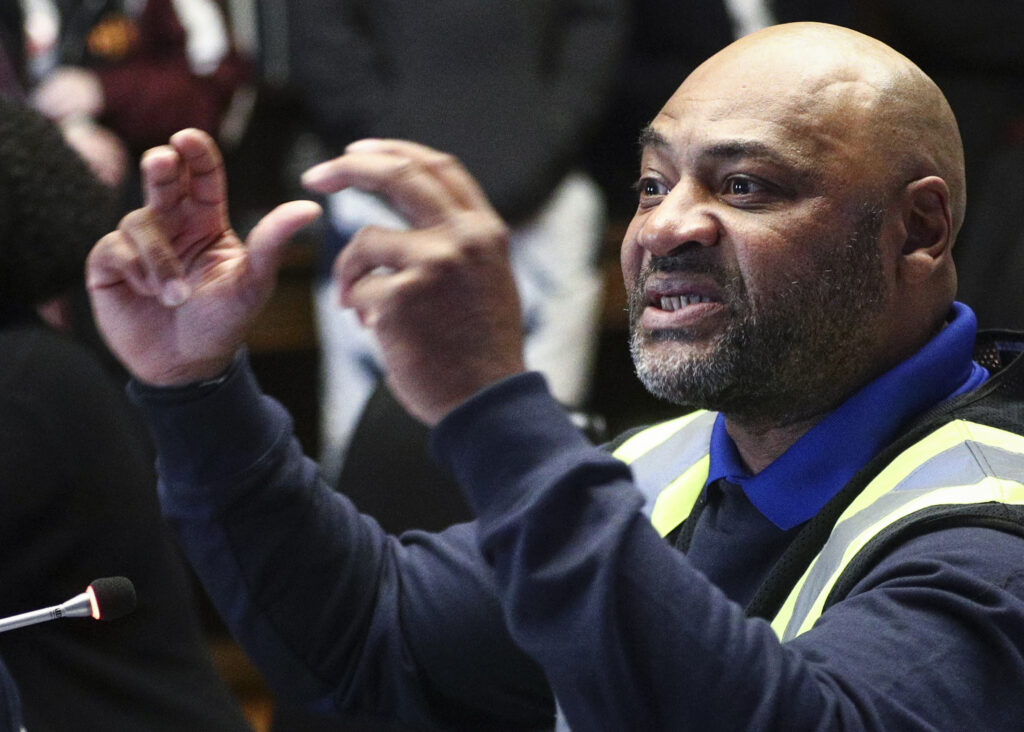
Arron Wheeler of the Newark Community Street Team testifies during a public hearing on opioid settlement fund spending on Oct. 22, 2026, at the Statehouse in Trenton. (Photo by Dana DiFilippo/New Jersey Monitor)
People like Arron Wheeler, Precious Kirby, and Jenna Mellor are usually out on the streets, helping those struggling with addiction by getting them into housing and treatment, providing clean syringes and hygiene kits, and saving lives by administering the overdose-reversing drug Narcan.
Thursday, they crowded into a standing-room-only meeting room at the Statehouse, fueled by anger and anguish, for a three-hour public hearing on how counties and towns have spent national opioid settlement funds that drug manufacturers, distributors, and pharmacies have been required to pay to resolve lawsuits.
The money is meant to directly help those harmed by addiction, but local officials in New Jersey and elsewhere have squandered millions since disbursement began in 2022 on concerts and other festival-like events billed as “public awareness” initiatives, police surveillance equipment and fitness gear, and more.
Advocates demanded oversight and urged lawmakers to set stricter guardrails on spending, with the state and local governments set to receive $1.1 billion through 2038.
“People died for that money!” said Wheeler, a harm reduction worker with the Newark Community Street Team. “Let’s get the money to where it belongs. My mother suffered from opioid use. My uncle died in an abandoned building because of prescription drugs. Let’s get this money to the people that it belongs to.”
Kirby, director of community engagement at Black Lives Matter Paterson, told legislators that people sometimes seek help from her group when someone overdoses.
“I’m not sure here who’s ever witnessed an overdose in person, but it’s pretty terrifying,” said Kirby. “When people are asking for our staff, they aren’t asking us if we have popcorn, cotton candy, or a nice $600,000 concert. They’re asking: ‘Who has Narcan?’ Because when someone is dying from an overdose, we don’t need a concert to remind us that overdoses exist.”
Assemblymen Avi Schnall (D-Ocean) and Cody Miller (D-Gloucester), the committee’s chair and co-chair, introduced legislation earlier this month that would expand oversight and transparency of opioid settlement funds.
But Schnall said they wanted to hear from people on all sides of the issue first and would use the testimony to improve the legislation, so the committee did not vote on the bill.
Miller, whose older brother and sister have struggled with addiction, said he found towns’ spending on things like police surveillance cameras and vehicles “abhorrent.”
“This is blood money. It’s for people that have lost their lives, and that’s what we need to spend it for: for treatment, for recovery, for prevention, for families, for individuals who have been impacted, Black and brown communities, everyone who has been impacted by this crisis,” Miller said. “We want to make sure the funds go to the people who need it the most, and we are going to fix this.”

Schnall called it “disgraceful” that many local officials have hoarded and not spent the money, even as the opioid crisis continues.
Overdose fatalities in New Jersey have declined in recent years, from 3,171 confirmed drug deaths in 2022 to just under 800 suspected drug deaths so far this year, state data shows. But racial disparities persist and thousands of people continue to overdose, with emergency responders preventing further deaths by administering naloxone in more than 9,500 incidents last year, data shows.
“People died for that money, and we are not enforcing and obligating and requiring that every dollar is planned,” Schnall said. “It’s disgraceful that we’re letting this happen, and we can’t.”
Their bill would require fund recipients to spend the money within 18 months, unless it’s for a multi-year project or they get approval from the state Department of Human Services to hold the money longer. Money unused within 18 months otherwise would be redistributed to jurisdictions that will spend it.
But advocates said requiring more thoughtful plans for the money would be better than setting a deadline for it to be spent.
A few mayors and county administrators seconded that sentiment, testifying that they welcome more guidance and examples of “good” spending to shape their decision-making. They urged legislators to create a position or commission where they could ask questions about planned spending.
Some of that already exists. A state panel issued a five-year strategic plan last year that advised officials to focus funds on treatment, housing, harm reduction services such as safe syringe sites and testing, and wraparound services that address other barriers to recovery like employment, education, food insecurity, and more. Fund recipients are required to publicly report their spending every fall, and some advocates seeking fuller transparency have investigated and reported on spending themselves.
Several public health officials alerted lawmakers that many towns exclude them from spending decisions and implored them to ensure they get a seat at the table.
Linda Brown is executive director of the New Jersey Association of County and City Health Officials, which represents 104 local health departments. She told lawmakers her group surveyed 25 departments and found that more than half of them reported that they weren’t consulted at all when their towns decided how to spend funds, with police, finance, or human services departments instead deciding.
Others asked lawmakers to make sure local officials stop using opioid settlement money as a “slush fund” to close budget gaps as the economy worsens and to prioritize community-led solutions.
“We want everyday residents, business owners, family members, and neighbors to have the tools to respond when these seconds matter. We are working every day to turn everyday community members into life-saving first responders. This is what meaningful investment looks like. It is practical, it is accessible, and it’s replicatable. It is rooted in public health, and most importantly, it has the potential to save lives,” Kirby said. “But organizations doing this work should not have to compete with publicity campaigns, entertainment expenses, or initiatives that lack any clear connection to evidence-based overdose prevention.”

Jenna Mellor, executive director of the New Jersey Harm Reduction Coalition, shared a lengthy petition she sent Thursday to Stephen Cha, commissioner of the state Department of Human Services, seeking new rules to ensure settlement funds are spent wisely.
“It’s time for the Department of Human Services to step up into that authority,” Mellor said. “It is a moral responsibility to do so.”
However lawmakers eventually amend the bill, Raquel Romans-Henry of Salvation and Social Justice urged them to prioritize in policymaking racial disparities seen in the opioid crisis and the recognition that addiction is a disease and not a crime.
“For decades, when addiction devastated Black communities, government responded with arrests, prosecution, incarceration, and surveillance. Today, we rightly speak about addiction through the lens of treatment, recovery, harm reduction, housing, and public health. And while that shift is welcomed, we have to tell the truth. When addiction showed up in Black communities, the state built prisons. When addiction showed up in white communities, the state built treatment systems,” Romans-Henry said.
She added: “Black communities endured the war on drugs, and now they are disproportionately bearing the burden of the opioid crisis itself. That reality should shape every single conversation about opioid settlement dollars here in the governor’s office, in the state, in county, and in local offices.”

