



Summary
- The Federal Election Commission has been unable to take official action since May 2025, leaving campaign finance complaints and investigations stalled.
- The agency’s inaction could affect New Jersey’s 7th Congressional District race, where Republicans have accused Democrat Rebecca Bennett of campaign finance violations. Bennett disputes the allegations.
- With more than $11 billion projected in 2026 election spending, watchdogs warn that weak enforcement could encourage violations and reduce accountability.
WASHINGTON — Once upon a time, the Federal Election Commission – created in the aftermath of the Watergate scandal – was seen as an important tool for policing the nation’s campaign finance rules.
The 2000 presidential campaign of former U.S. Sen. Bill Bradley took in $14,055 too much in public contributions, according to one FEC audit.
After the 2018 campaign cycle, when U.S. Rep. Jeff Van Drew (R-2nd) ran for his South Jersey seat as a Democrat, a federal review found his campaign took in $45,600 in “excess” contributions and $13,255 from “apparent prohibited” sources.
Fast-forward to this month, when officials within the New Jersey Republican Party filed a formal complaint with the FEC against Rebecca Bennett, accusing her of violating federal law and spending more on television advertising than allowed. It’s a charge disputed by Bennett, who is running against U.S. Rep. Tom Kean Jr. (R-7th) in New Jersey’s lone toss-up race.
But no audit will likely follow anytime soon, as the FEC’s campaign-finance investigations have been mothballed and the complaint against Bennett will not be acted upon before her campaign ends on Nov. 3, Election Day.
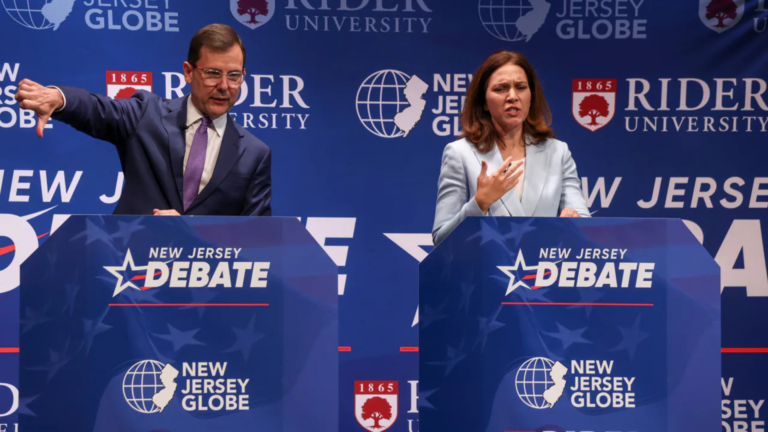
Two weeks from the midterm elections, the Federal Election Commission, the primary federal agency that runs campaign audits, processes complaints, advises political groups about how to follow the law, crunches political-spending data and serves as America’s campaign-finance watchdog, is severely hobbled.
The FEC has been without a quorum since May 2025, the longest such lapse in the commission’s history. It has two commissioners — out of a possible six — short of the four needed to conduct official business.
“They can’t take any official action,” Shanna Ports, senior legal counsel at the Campaign Legal Center, a nonpartisan watchdog group, said in an interview with NJ Spotlight News.
“When they get complaints alleging that somebody broke the law, they can’t act on that and hold people accountable,” Ports said. “The complaints sit in a void.”
“The FEC right now can’t even represent itself in court,” said Michael Beckel, who tracks money in politics at Issue One, a nonprofit that backs campaign finance reform.
In September, Shana Broussard, the acting FEC chairwoman, said the backlog of matters before the commission had roughly doubled from 154 to 307. “We need a quorum to tackle this backlog and fully achieve the agency’s mission this election,” Broussard said at the time.
Trump’s picks and firings
President Trump in February submitted two FEC nominees to the Senate for confirmation, but the Senate Rules Committee, which has jurisdiction over elections, has yet to hold confirmation hearings. The committee chairman, Kentucky Republican Mitch McConnell, was out of Washington for months this year due to health issues.
Trump then fired the former FEC chair, Ellen Weintraub, in early 2025 — an act Democrats denounced as illegal.
“The FEC was created by Congress to be independent of control by any political party, and no President has ever fired a commissioner since its creation over 50 years ago,” Democrats in the Senate wrote Trump in March 2025.
Two Republican FEC commissioners resigned in the months that followed.
“The FEC’s ability to meet its mission is significantly impaired when it has fewer than four members,” Susan Ruge-Hudson, the agency’s inspector general, wrote in a recent report to Congress.

The FEC, she noted, cannot hold hearings, write rules, file a lawsuit, authorize investigations or refer potential wrongdoing to other agencies.
“Additionally, the agency is unable to conduct crucial administrative business, including hiring permanent staff for senior positions and adopting new agency-wide policies, which makes it very difficult, and in some cases impossible, for the agency to ensure compliance with all directives issued by the new Administration,” Ruge-Hudson wrote.
A White House spokeswoman did not respond to a request for comment about efforts to confirm the two nominees.
The Senate is not scheduled to return to work until the week after the midterm elections.
Trump said Tuesday he has spent more than $300 million on the midterm elections and would spend $100 million more, remarks that likely refer to outside spending from super PACs aligned with Republicans.
Mandatory financial disclosures and campaign reports are still being filed, and processed, said Beckel.
“It’s all the things beyond just being a transparency clearing house that are really frozen and stuck at the moment,” he said. “In the meantime, complaints against potential rule breakers can continue to be filed.”
Remaining powers
Analysts at the agency can also write campaigns and outside groups, such as union, corporate or issue-oriented political action committees, or PACs, for more information. Those letters are known as “requests for additional information” or RFAIs.
“Certainly that’s part of the compliance process, making sure all the I’s are dotted and the T’s are crossed,” Beckel said.
The statute of limitations for the FEC to seek civil penalties in court is five years.
Potential wrongdoers are aware of that time frame and operating in a window that incentivizes rule-breaking, Ports said, adding any penalties the FEC could levy would come after the elections.
“There’s a sense that there’s not an enforcer in town and entities don’t have to play by the rules anymore,” she said.
The 2026 elections are expected to be the most expensive on record, with more than $11 billion projected to be spent, surpassing the 2024 presidential election cycle.
With this backdrop of record spending, and a sidelined FEC, political operatives are pushing boundaries of what is permitted in campaign finance.
Ads generated with artificial intelligence tools have been deployed, for example, typically without being properly labeled for the viewer. The Wesleyan Media Project, an organization housed at Wesleyan University, said in early September it had identified at least 164 political ads “generated or enhanced through” artificial intelligence tools during this campaign period. Sixty-nine percent of the commercials did not include disclaimers that AI had been used to create them.
Other newer tactics include so-called “pop-up super PACs,” groups that spend unlimited sums and file financial disclosure paperwork right before an election, to avoid public scrutiny — and closer coordination between candidates and outside groups, which is illegal.
“When spending is at its peak, that’s when there’s the greatest potential for violations because there’s so much happening,” Ports said.
“At the moment, it’s certainly just in limbo,” Beckel said of the FEC’s status.
